
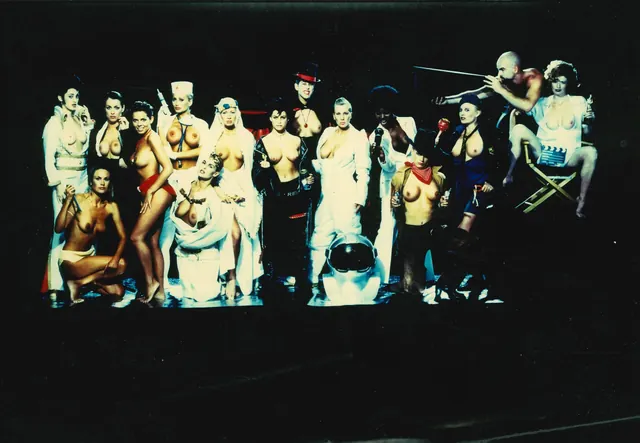
Manumission was an iconic emblem of 90s Ibiza nightlife. On 26 September the institution returned for one night only. The full lineup was kept under wraps and guest were asked to arrive in 90s attire with a mask and an open mind. Held at Ibiza 528, Le Weekend MANUMISSION was the place to be, packed with locals and international music lovers hungry for a taste of what made Manumission so worthy of revival.
The sheer scale of 528 Ibiza meant each of the five open-air stages embodied its own unique concept. There was a nod to Manumission’s queer roots on the main stage as dancers, drag queen and acrobatic artists performed in a three-story replica of the Manumission Motel, based on founder Claire Manumission’s memoir “ The Motel: High Times in 90s Ibiza .”
“ A Cuban circus master conducts the aerial and ground acrobatics, while Barcelona drag queens play ’90s supermodels Claudia Snipper, Yasmin Le Bon Bon, Naomi Cowbell, and the deliciously decadent Cake Moss in a reenactment of the now-legendary Manumission Paris Fashion Week party,” described founder Mike and Claire Manumission in press statement. The soundtrack was filled with throwback classics and the theatrics made it the life of the party.
Over at Bedroom Bondage à la Japonaise stage held by party collective, XTRA, the theme was pure after dark. On top of the DJ booth laid a gigantic nude blow-up doll bound by rope and the collective’s mission to “Make Ibiza Queer Again” set the tone for a stage of fun and underground DJs dressed in leather with some of the best dance sounds we heard throughout the night.
From the NYC strip club theme of Le Theatre Pink Pussy stage to the Roger Moore’s Dark Room stage curated by Nick Sheehy from Pikes Ibiza, there was truly something for everyone at Le Weekend MANUMISSION. The 12-hour extravaganza brought the spirit of summer ’98 back to the island. With its no-phone policy, the night reignited the free-spirted magic of Ibiza.
photography. Courtesy of Manumission words. Shama Nasinde
Over the past three years, David Schütter ‘s career has taken him through a striking range of worlds, characters and creative roles. He has moved between acting and producing, founded his own production company, developed new projects, and kept seeking stories that let him step outside the boundaries of everyday reality.
From dystopian politics and vampires to fantasy, animation and the melancholy poetry of Schubert, his recent work reflects a fascination with characters who find themselves caught between opposing worlds — between idealism and ambition, reality and fantasy, belonging and isolation.
In ‘City of Blood’, he plays Oliver Lawal, a politician who begins with a genuine desire to represent people who have been overlooked before gradually becoming consumed by the pursuit of power. The role gave him an opportunity to explore the uncomfortable distance between political ideals and the compromises that can emerge once ambition takes over.
The series also allowed him to work within a dystopian world that, during filming, sometimes felt uncomfortably close to reality.
His interest in fantasy goes back much further than his recent work. As a child, he painted miniature figures, creating his own small fantasy worlds long before acting became his profession.
Today, he continues to be drawn to stories that offer an escape from reality while also finding ways to examine it from a different perspective. For him, fantasy isn’t simply escapism; it can be a way of approaching difficult subjects indirectly, allowing audiences to see familiar ideas in unfamiliar worlds.
Now, with more projects in development and a series he plans to continue writing while spending time in Sicily, he is embracing another chapter of an increasingly varied career. Schön! spoke with him about the creative freedom of working across different sides of the industry, the complicated transformation of his character in ‘City of Blood’, and more.
full look. Prada opposite coat + trousers. Brunello Cucinelli shirt. Dries Van Noten
You last spoke with Schön three years ago. What have you been up to, and how has that time been for you creatively?
I’ve been blessed with very different roles and characters to speak through, and worlds to move through with them. Nothing has resembled anything I’d done before.
So I would be a fool to complain about any of it. Along the way, I also founded a production company.
We currently have a one-person play running in Switzerland, and we’re developing a series for a streamer that I co-wrote with a man in prison. For three years, we talked on the phone.
Or rather, whispered. That’s how the project grew.
I can already tell you where we ended up, genre-wise. Not very surprising, I’m afraid.
The entire thing is set in the criminal underworld.
There’s also a very special project I’ve been developing with a good friend of mine, a director and the photographer behind this very editorial, Ruben Nicolas Meier, set to shoot next year. More than that I can’t say.
Top secret, for now. Being a producer has also shown me the industry from the other side.
I understand a lot of decisions now that I didn’t understand before, including some that were made about me as an actor. I see the whole picture much more clearly now.
As you’ve been working on both sides of the industry, have you seen any changes or trends that make you hopeful about the future of the industry, or about your work as an actor and producer?
I think Germany in particular is getting braver about the subjects it takes on, and ‘City of Blood’ is a good example. It’s set in the future, but it’s really about now: populism, poverty, climate change. Telling that as a dystopia takes courage. It’s not a typical German production, at least not by the standards of the last few years.
I know everyone is nervous about AI right now, and not without reason. It will take over parts of the work. But people will keep wanting things made by people. Fast fashion didn’t kill the tailor. It made him a luxury. So I’m trying to be more curious than nervous. I do say please and thank you to it, though. Just in case.
Speaking of escapism, ‘City of Blood’ is set in a dystopian future. What was it about the story that interested you? And in your last interview with Schön, you said you might have been interested in becoming a politician had you not gone into acting. Did that influence your interest in playing Oliver Lawal, who is a politician in the series?
There are so many careers that would at least be interesting, even adventurous. But what fascinated me most about Oliver was how fast idealism can turn into opportunism.
You see it all the time in politics, and you see it in my world too. Actors start out wanting to tell a story, and later they just want a job that puts food on the table.
Producers want to tell the untold stories, and later they just want the contract. I know how that shift happens, and I could translate it to a politician.
And then the establishment gets its hands on you, and your ambitions quietly shrink. The gap between what you promised and what you actually deliver just keeps widening, and at some point you stop measuring it altogether.
sweater + trousers. Ralph Lauren shirt. Lardini boots. Jimmy Choo
coat + turtleneck. Loro Piana gilet, shirt + trousers. Like A Casino
Oliver starts out trying to represent people who are underprivileged and poor, but when he realizes he can reach a certain level of power, he starts selling out. What drew you to that transformation?
I live in Neukölln, and I’ve lived here for ten years. It’s one of the poorest districts in Berlin; it’s predominantly Arab, and in some corners the only hint that you’re still in Germany is the street signs.
Every Arab culture has found its way here and brought its kitchen along. You can eat the best kafta, shawarma, and falafel on every corner.
I love the place. Parts of ‘City of Blood’ are set here, and it’s where Oliver comes from.
Oliver starts genuinely wanting to fight for people like his neighbours. He founds Aufbruch Berlin for the ones who aren’t seen, who don’t have money, who live in districts like this one.
And then, slowly, that changes. Because wanting to be chancellor is a different ballgame entirely.
I recognise that tension. I grew up in a poor district in Hamburg, and I still find myself at industry events surrounded by people wearing jewellery that could feed a family for a few months, smiling and saying nothing.
Because at some point you’re playing the game as well, whether you like it or not. That’s the quiet compromise I brought to Oliver — and watching it consume him from the inside was the most interesting part of the whole role.
The political landscape in ‘City of Blood’ is primed for somebody like Oliver. He starts off wanting to represent the underprivileged, then begins selling out as he sees the possibility of power. The public doesn’t know what’s happening behind the scenes—they’re seeing what he’s saying and resonating with it. Then he starts getting manipulated from behind the scenes.
The strange thing about the shoot was that the political climate outside kept darkening, week by week. Especially in America, things were moving in directions that felt more dystopian than anything we’d written. We actually had to go back and sharpen scenes mid-shoot because they’d already started to feel dated. So even though our story was set in the future, reality almost overtook us.
He starts off with a populist mentality and then slowly slides into fascism.
Yes, all the way. There’s actually one line I wrote myself, specifically to mark the turning point: “Everybody wants to come to Berlin, but we are from Berlin.” That’s the fascist moment.
We added it during the rework, and it landed exactly where it needed to. The most remarkable thing about filming the big speech was the extras.
To set the scene: my party’s headquarters is an empty swimming pool. There’s no water in ‘City of Blood’.
It’s 42 degrees, permanently. Water is a luxury.
Populism has a very specific rhythm. You ask a question and immediately answer it.
Every five to ten sentences you need a punchline, like a flavour enhancer, something that keeps people hanging on your every word. It’s designed for people looking for simple answers to complicated questions, and it works by never letting the energy drop.
Our extras were Czech. Five hundred people who didn’t speak a word of German.
Nobody held up a sign, nobody gave a cue. And yet they knew exactly when to clap, every single time.
I still find that deeply unsettling. Because it means populism doesn’t need a shared language.
It has its own.
It’s powerful, but also dangerous. There’s a sense of dread in that scene, because Oliver has gone so far down that path. Even though there are moments throughout the series where you can see doubt and fear, he keeps doubling down.
What’s frightening isn’t how far someone like Oliver can go. It’s how quickly he gets there. And what travels with him is his following. You see it everywhere in the world right now: people who started as citizens, voted, and radicalised themselves into soldiers almost before you notice. In the series, they literally hand me weapons. “Let’s armour up,” they say. “Let’s go out there and do it ourselves.”
I liked that we also got to see both angles. We’re not just seeing him as a politician from the outside; we’re brought into his internal world as well. We see the doubt and fear, and also the family dynamic—with his wife, his father-in-law and his brother, who is still in the poorer neighbourhood. We see him essentially take advantage of his brother for a photo shoot.
God, it’s ugly. That’s where it begins, the first drops of poison finding their way into everything he once stood for.
And then there’s the manipulation from Johan and the vampires. It gets to a point where you can tell he’s not believing what he’s saying, but his desire for power and to win is so powerful.
I think that’s what it feels like when you no longer believe yourself. I know it from personal experience. You have to be clever enough to lie to yourself and stupid enough to actually buy it. The results aren’t always particularly wholesome. But as a strategy, it’s remarkably effective.
coat. Brunello Cucinelli shirt. Dries Van Noten opposite full look. Diesel
full look. Like A Casino trousers. Diesel opposite full look. Prada
At the very end, in his final scene with Zeno and Bea, he accepts that little shot of blood and essentially thinks, “Fuck it. We’ve gone this far.” If the story were to continue beyond the season finale, where do you think Oliver could go in his relationship with the vampires?
My end looks very much like a beginning. Oliver Lawal is finished. Chancellor Lawal of Aufbruch Berlin is just getting started. Which, as a party name, has always sounded faintly militaristic to me. What happens next with the vampires is genuinely open. Some of them are decent. Most of them we don’t know yet. And that ambiguity is very deliberate, because the question Oliver is really facing isn’t about vampires at all.
The vampires are a metaphor. It’s about whether you let people in from outside, and what you do with them when they arrive. You can read them as the stranger, the outsider, the one who doesn’t belong. Or you can read them as parasites. That’s a matter of perspective. And what interests me personally is the third option: you let them in, you open up, and you grow into something new together.
Because the alternative, pressing a residency permit into someone’s hand with a set of instructions attached — learn the language, adopt our culture, live as we do, or you are not welcome here — has consequences. Those consequences are exactly what we’re seeing now.
I think it’s a large part of why people are angry, why they’re becoming more receptive to populism, and why the polls and recent elections look the way they do. A far-right extremist party is back.
It’s a global phenomenon, I know. But of all countries, Germany.
Disgusting, to be honest. I just hope the pendulum swings back just as hard, and soon.
It’s a global phenomenon, unfortunately.
I always thought we’d learned enough not to keep making the same mistakes the moment just enough time has passed. But human adaptability is an astounding thing.
We get used to peace. We get used to prosperity.
We get used to absolutely anything, given enough time. And the same quality that helps us survive the worst also makes us comfortable with things we shouldn’t be comfortable with.
Scale that across a country, and political catastrophe stops being a distant possibility and starts knocking on all of our doors.
To pivot, there’s another vampire thriller you’re part of, ‘Flesh of the Gods’. You’re reuniting with Kristen Stewart in this film. Is there anything you can tell us about your character, your role or the film in general?
Let me put it this way: it was special enough to get Kristen Stewart back into a vampire movie. That’s really all I can say about the film itself.
But the set was unlike anything I’ve experienced. Every single department was spot on, the best I’ve seen across the board.
I loved the way they worked, how flexible it all was. Standing there, I remember thinking: this might just be the best thing I’ve ever been part of.
You said you’re on the other side of things for this film. Does that mean your character is a vampire this time around?
There are vampires, yes. And this time, I might just be on the other side of things.
Since you have these two vampire projects, a fun question: If you were given the choice, would you want to be a vampire?
I’ve thought about it a lot; my conclusion is that I couldn’t resist. Even if you stop feeling anything, even if the real world casts you out and you have to hide all the time, there’s something seductive about an existence that is simply not permitted. The stolen apple always tastes sweeter than the one you paid for.
bomber coat, shorts + boots. DSQUARED2 tank top. Lacoste opposite bomber coat, shorts + boots. DSQUARED2 tank top. Lacoste
sweater. Ralph Lauren shirt. Lardini opposite full look. Dries Van Noten
Another upcoming film is ‘Geister (Ghost Song)’, which is opening at the San Sebastian Film Festival. It sounds really interesting.
Yes, ‘Geister’, Fatih Akin’s new film. I only have a very small part, and I should be upfront about that: I’m not the important one here.
The young actor is, and the story is incredibly moving. Fatih Akin is a legend, especially where I’m from, in Hamburg.
There are things in life you simply don’t say no to. When he whistles, I come running.
I play a psychiatrist at the hospital, following an incident I won’t go into further. A character who very much cares about the lives of young men.
As we all should. More than that, I really can’t tell you.
Is it fair to say you’re drawn to stories with supernatural or fantasy elements? There are quite a few in your career.
There are quite a few, and right now I’m actually doing a children’s film where I transform into a cougar. So yes, I’d say the pattern holds. ‘Lord of the Rings’, vampires, ‘House of the Dragon’, I love all of it. Because the best thing about filmmaking is that you’re not obliged to face reality every single time you sit down to tell a story.
Even when the story is true, a little movie magic never hurts. There’s something genuinely beautiful about imagining worlds beyond our own.
Fantasy lets you breathe. It takes you somewhere else, and reality can be exhausting.
Sometimes devastating. Occasionally just dull.
Not always, of course. But fantasy tends to be none of those things.
The distance it creates isn’t just escapism. It’s also a tool.
If you criticise someone directly, they’ll defend themselves. But wrap the same critique in a fairy tale and suddenly people are willing to sit with it.
You mentioned ‘House of the Dragon’ and ‘Lord of the Rings’. Are there any fantasy worlds that you would love to be a part of, whether professionally or just out of curiosity?
Any of them, honestly. All of them.
Though I should tell you where the obsession started. When I was twelve, I used to paint miniature figures.
I could never concentrate on anything for more than twenty minutes, but for one brief period of my life there was complete silence in my room, which was, apparently, a completely new experience for my mother. I’d sit there for hours painting their tiny eyes, their armour, every detail.
Those little figures were my first fantasy world. The problem was they were far too expensive, so the silence didn’t last.
Another upcoming project is ‘A Winter’s Journey’. Anything you can tell us about that? I know it’s been in production for quite a while, and I don’t know whether it has a release date yet.
I love Schubert’s Winterreise, and one song in particular: “Der Leiermann.” Find the version sung by Thomas Quasthoff on YouTube. There’s something about that melody I can’t explain, but I think it’s the endless melancholy.
And I love melancholy. That feeling when it’s raining outside, and you’re inside by the fire.
The love of sadness. Finding beauty in it.
That’s what melancholy is, to me. This song cycle had been part of my life for a long time.
So when they called out of nowhere and asked if I wanted a small part, I didn’t need much convincing.
It was one of my first English-language productions, with a lot of dialogue alongside the songs. The whole film is painted in the style of Caspar David Friedrich, and by the way, we share two of his names: David and Friedrich. Friedrich is my middle name, after my grandfather.
I got to work with John Malkovich and Jason Isaacs, both of them phenomenally talented. And the way they shot it was extraordinary.
At one point I snuck a look at the director’s monitor and couldn’t believe what I was seeing. I had to take a photo.
On the screen, it already looked like a painting. Now a whole team is actually painting every frame, which is why it’s taking four years.
Everything about that project was poetic, in the best possible sense. What was harder to romanticise into something poetic was my financial situation at that point.
I was broke, with more bills than I could count, and one week away from being kicked out of my apartment. We shot in Poland, and there was a small casino underneath the hotel.
I asked the producer to pay me daily. I pocketed the money and went downstairs.
I didn’t fully know the rules of blackjack. A very kind Chinese gentleman at the table quietly explained them to me. A small crowd gathered. I played, I won, and I walked away with fifteen times what I put in. I was able to pay every single bill. That film brought me luck. I’ve never set foot in a casino since.
The film is being hand-painted frame by frame, which makes the production incredibly labour-intensive.
It’s a little miracle, and in some ways wonderfully old-fashioned, like hand-drawn animated films from back in the days. 24 frames per second, each one a separate image, just to create the illusion of movement.
Multiplied by 90 minutes. The sheer number of paintings is insane.
And I believe that choosing this kind of labour over the easier path breathes what one might call a real soul into a project, one an audience can feel.
Did you sing in the film at all, or was it purely dialogue for your character?
No singing, I’m afraid. I dance, though. It’s actually quite a big dance scene, and a dramaturgically important one.
I’m heading to Sicily for a few months, through November and into the winter. I’ll keep writing my series there. Berlin gives you a lot of things, and I’ve always been grateful for that. But right now it’s time to let Berlin be Berlin, rest my head, clear my mind, and take endless walks through Bella Italia.
You can stream ‘City of Blood’ on Disney+.
photography. Ruben Nicolas Meier fashion. Ridvan Cavus talent. David Schütter hair + make up. Fabienne Hoppe editor. Kelsey Barnes interview. Suhaila hair + make up assistant, sfx. Paula Baginski assistant. Svenja Blobel
With a violin in her hands from age two and a childhood soundtrack of Joni Mitchell, Carole King, and James Taylor, EMMMA has always understood a song’s emotional power . Raised in Connecticut and now based in London, the multi-instrumentalist and songwriter is entering a new chapter—one defined by creative freedom, emotional risk and a refusal to make music for anyone but herself.
After a breakout year that saw Elton John champion her music on Rocket Hour, BBC Radio 1 support her singles, and major tours with Suki Waterhouse and MUNA, EMMMA is now building toward her debut album. Her latest single, ‘Fall From Grace’, is a cinematic breakup song about leaving a place behind and confronting the feeling that doing so somehow means you’ve failed.
For EMMMA, however, leaving Los Angeles became less an ending than an act of self-discovery.
Ahead of her upcoming UK and European dates with MUNA, EMMMA speaks to Schön! about finding her voice, learning to trust her instincts, the places that have shaped her, and finally permitting herself to make music entirely on her own terms.
You started playing violin when you were just two. When did music shift from something you were learning to something you wanted to create and pursue as a career?
I think I always knew I had to pursue music; it was just a question of in what form. I was very into musical theatre for a while, but I realised I preferred singing songs that I had written myself. That was the biggest awakening for me. When I applied for the songwriting course at Berklee, I became pretty sure that this was going to be my career.
You grew up listening to Joni Mitchell, Carole King and James Taylor at home. What do you think you absorbed from those artists without even realising it at the time?
I think they were the perfect artists to learn how to write stories from. Listening to the way they used words to paint imagery was so masterful that I think it became ingrained in me without me even trying. It was like a masterclass in poetry.
Was there a particular song you wrote where you first thought, “This actually sounds like me”?
I think that happened when I was at Berklee. I wrote a song that really changed my perspective on what I wanted to be as an artist. It didn’t necessarily translate directly to the artist I am today, but at the time, it was a huge milestone. I finally felt like I was writing for myself.
Were you always someone who used songwriting to process what was happening in your life, or did that come later?
When I was in high school, I would sit at the piano and write songs to process my feelings all the time. That’s kind of where my love for it started. I would sit at my mum’s grand piano with a yellow legal pad, handwrite my lyrics and write song after song. Not that they were all necessarily good, but I definitely felt like songwriting was my emotional outlet.
Has your songwriting process changed much since you first started writing? What usually comes to you first now: a lyric, a melody or a feeling?
Now, compared to when I was younger, I have to process my feelings more before writing them down. I’m also definitely more critical of my lyrics now because this is my career and not just my hobby. I always have to come into my sessions with a concept or a feeling, and if I don’t, I feel like I’m not productive.
A lot of your songs explore heartbreak and emotional risk. Do you find it easier to write about something while you’re experiencing it, or once you’ve had some distance from it?
It honestly depends on when the session is. I do always feel better when I write about a situation, but sometimes I’m in it and sometimes I’m out of it, depending on when my writing period is. Sometimes I’ll take a period off to focus on performing, and I won’t write, and then I’ll come back to those situations later when I’m in my writing period.
You’ve described ‘Fall From Grace’ as a breakup song with a place. What made leaving that chapter of your life feel so emotional?
I think I spent so much time in Los Angeles that it felt really strange to move, especially when so many people regard it as the place to be for songwriters and artists. I really didn’t resonate with it as a place that felt safe for me creatively, so I had to reassess my relationship with it. Writing this song really helped me with that.
There’s a feeling in the song of thinking that leaving somewhere means you’ve failed. Have you come to see that differently since writing it?
I know it doesn’t mean I’ve failed, as London has proved to be much more creatively and emotionally fulfilling for me. I think there’s a pressure from the world that makes you feel like LA is the only place to be, but that’s just so not true. It’s interesting to listen back to the song now that I know that isn’t the case.
You grew up in Connecticut and now live in London. How have those two places shaped you, both personally and creatively?
Connecticut was a really beautiful, safe place to explore songwriting and music and to realise that this was the career I wanted. London has given me the opportunity to act upon that career. They’re both great places for different reasons.
You’ve had some pretty incredible moments recently, from Elton John playing ‘Russian Roulette’ to BBC Radio 1 supporting ‘Experiment’. Do those moments feel real yet?
They’ve been so much fun for me. It felt the most real when I called my parents, and we had a little scream about it. It was just so much fun. Milestones are so important to celebrate, and sometimes I can forget to do it, so when I can, I really try to appreciate them.
You’re now heading out with Suki Waterhouse and then MUNA. What have you learned about yourself as a live performer since you first started playing shows?
I definitely love connecting with the audience. When an audience member comes up to me and tells me I’ve helped them understand something about themselves, it makes it all worth it. I’ve just had the best time connecting with new people, and I can’t wait to continue doing it.
You’re building toward your debut album. Does the person who started writing those first songs feel very different from the artist making this record now?
Yes, absolutely. I think I’ve become a lot less apologetic, and I’m making music now that I’d actually want to listen to. I think I’m also pushing the boundaries of what I thought I could be. It’s so exciting to see this come to life.
If you could sit down with the younger EMMMA who was just beginning to write songs, what would you tell her?
I would tell her not to make music for her parents or her friends, but only for herself. It’s so important to allow yourself to be unapologetic about your choices. I think I’ve only started to allow myself the freedom to do that now—to make music that is loud and angry, or sad and quiet and expressive, because that’s what I want to make, not because that’s what other people expect of me.
photography. Lune Jusseau editor. Kelsey Barnes
Fifteen years after Iranian-American author Tahereh Mafi released ‘Shatter Me’, her dystopian world feels newly relevant, and her readers have transformed it into something bigger than she could ever have pictured. With the influence of BookTok (and a film currently in production with Warner Bros.), the New York Times bestselling novel has stood the test of time, cementing itself as a must-read young adult story.
Since then, Mafi has gone on to publish several novels across the young adult and middle-grade space, but the world she first created remains one of her most enduring works.
Mafi returned to the ‘Shatter Me’ universe last year with ‘Watch Me’ – the first instalment of Shatter Me: The New Republic series – feeling as though she needed to retreat to dystopia to make sense of the world’s current landscape. “ Often, I return to fiction as a means of working through questions, fears and feelings I’m having in real time,” she shares with Schön!.
Set 10 years after the fall of The Reestablishment, the new series follows James and Rosabelle, with the third novel, ‘Escape Me’, seeing their connection deepen.
Sitting down with Schön!, Mafi looks back on ‘Shatter Me’, delving into the dystopian world she created and the underlying message woven throughout her work.
Congratulations on ‘Escape Me’ and the 15th anniversary of ‘Shatter Me’! When you look at ‘Shatter Me’ now, did you ever imagine that it would still be generating this much conversation in 2026? What has surprised you most about its longevity?
I never could have imagined. I mean, you hope and pray to have a career or job that lasts long enough to sustain you, but I certainly could not have imagined.
I’m just so grateful to still be doing this, to still have these books on shelves. I think the thing that surprised me the most is how many people have resonated with Juliette as a character, because the books can be – the first book in particular – really polarising.
It’s written in this really chaotic, almost stream-of-consciousness kind of way, told from the first-person perspective of a girl who’s slowly losing her mind. The writing really reflects this interior conflict and chaos, and I didn’t know whether it was commercial enough to be able to transcend so many boundaries into diverse and disparate spaces, even fandom and readership.
And that’s been really cool to see.
It’s really taken on a new life, especially with BookTok and that community being able to transform the way books become popular. Seeing not only new readers discovering it now through BookTok, but also readers like myself – who read the series when it came out – rediscover it and resonate with it in a new way is pretty interesting.
Does seeing readers build communities and traditions (like baking cakes for Warner’s birthday) around the series ever change the way you think about your own characters?
Yes, absolutely. It makes me feel more protective of the books and the characters because of the nature of this particular character, who is dealing with mental illness, trauma and anxiety.
And so many of the characters in these books are dealing with similar issues. I am reminded that this series is grappling with many issues.
Obviously, it’s in a dystopian world, there’s romance, but at the end of the day, these books are about overcoming trauma. And the bigger the fandom becomes, the more I feel protective of the fandom.
Because I recognise that they are connecting to these characters and to the struggles of these characters because of their own pain, because of the things that they’re experiencing. We saw a specific spike in readership in the BookTok world around 2020 when COVID hit, and everyone was trapped in their houses, and Juliette is trapped in an asylum.
And there’s a clear parallel between these experiences, and it’s helped me, as a writer, understand how powerful a story can be, especially when we writers are so often alone in this experience. I spend most of the day by myself, usually in a room by myself, and to be reminded how many people can connect to these stories and still have similar experiences makes me feel really responsible and protective of the people who read these books and care about them.
With the film adaptation now in development at Warner Bros., is there an element or scene in ‘Shatter Me’ that you are most excited to see translated on screen?
I’m particularly interested in seeing the dystopian world really come to life on the screen. I think it’s extremely important to make sure that the emotional throughlines of the characters are consistent and that the characters are represented in a way that feels authentic to the story and readers.
But I think, sometimes, the conversations around this series are reduced to just the romantic relationships, and I’m looking forward to the opportunity to depict the more terrifying realities of the dystopian universe in these books that feel more and more current every day because there’s also something there that’s really important to share visually on the screen. Now, perhaps more than ever.
In an interview, you had shared that returning to the world of ‘Shatter Me’ gave you a familiar feeling of comfort. How did you know that you’d found a new avenue or story to tell with The New Republic series?
You know, my process is never very obvious to me as it’s happening. It’s usually clear to me in retrospect.
Later, I’ll look back and see how something I was working through in real time allowed me to ask the questions necessary to propel myself into any story, whether it’s ‘Shatter Me’ or The Woven Kingdom series or any of the other books that I’ve written. When I had the idea to return to the Shatter Me universe, I was still actively writing a fantasy series, which I’m still working on publishing simultaneously.
I think I needed to return to the dystopian world because the world around me was feeling so dark, and so actively dystopian, that subconsciously, I just found myself wanting to return to fiction as a means of looking for solutions or using fantasy as a metaphor. I wasn’t 100% aware at the time that that’s what was happening.
But often, I return to fiction as a means of working through questions, fears and feelings I’m having in real time. So, it was helpful to come back to dystopia and look for hope.
Now that you’ve reached the third book in the series, ‘Escape Me ’, James and Rosabelle have had a lot of time to grow and change. When you first began this story, did you know where their journeys would take them, or did they surprise you as you wrote?
Books always surprise me as I’m writing them. Characters always surprise me as I’m writing them. But I did generally know I wanted to tackle artificial intelligence, hyper-surveillance and the really terrifying ramifications of unchecked, unregulated technological advances encroaching upon our humanity. As always, I like to explore these terrifying concepts through characters who find love, hope and found family, and help each other find a solution through that darkness.
Within ‘Escape Me’, and the series as a whole, is there a feeling or a message you hope readers take with them long after they close the book?
I think, for me, the answer remains the same with every book I’ve ever written. I’ve realised I have themes as an author that I come back to over and over again.
The essence of everything I write, I think I’m always trying to tell people in general – anyone who’s reading my books, but especially young people reading my books – that their pain matters, that their fears matter and that they’re not alone, they’re not the only ones with these fears, they’re not the only ones with these feelings and that we can come together as a people, with our shared humanity, to find our way through darkness.
‘Escape Me’ is available from September 29th.
photography. Ransom Riggs interview. Amber Louise