
In 1988, Miuccia Prada presented her first women’s ready-to-wear collection; Helmut Lang was well-established as an independent designer in Vienna showing his men’s and women’s collections on the Paris fashion week calendar; and Raf Simons was 20 years old, studying industrial and furniture design.
Why zoom in on 1988? Because this was the year that Maël Larcher (né Lee Young-Kyoon) and Xiaoyu Jiang were born—and it is the name they have given their archive showroom in Paris, which is well stocked with rare pieces from the designers above.
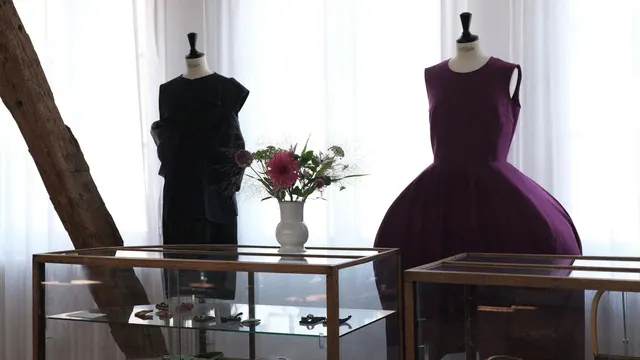
Since mid-June, the husband-wife duo have been welcoming people—by appointment only—into a serene, light-filled space high above the bustle of the Quai des Grands Augustins, a few hundred feet from Notre Dame.
While Paris abounds with showrooms and premium resale shops, their focused concept and niche selection have quickly gained a cognoscenti following. For starters, their inventory of some 2,000 pieces is a mix of high-end designer and American vintage, available for rental or purchase.
Several of their early Helmut Lang pieces—dense wool jackets with Tyrolian embellishments, for instance—are so singular that the owners are unprepared to part with them. They have a Phoebe Philo Yves Klein Blue body print dress from the Celine spring 2017 collection that hangs from the wall like an art piece.
One of the Larcher’s oldest and most cherished pieces is a pair of Malcolm McLaren pants with a low-slung band and buckle given to him by Kim Jones.
Then there’s the curation aspect. Just because Miuccia, Helmut and Raf represent their holy trinity, doesn’t mean they carry these names exclusively.
I spotted an early Christophe Lemaire workwear jacket; Comme des Garçons Homme Plus Bermuda shorts covered in micro green sequins; a Jil Sander (albeit Raf era) navy knit cardigan with a ribbed border; and a Louis Vuitton x Rei Kawakubo bag recognizable for its cutouts. Regarding American vintage, they have brands that date back to the 1930s, like Sweet-Or and cult names from the ’50s and ’60s such as Russell, Flagg, Champion and Mayo Spruce.
Ask and you’ll be shown the crewneck sweatshirts with Charlie Brown “Peanuts” graphics that boast perfect flat lock seams.
As a menswear designer, Larcher can go granular on details. He spent 10 years at Dior Homme: two years as an intern with Kris Van Assche, followed by eight years as a designer in Jones’s studio, making the transition to the first season of Jonathan Anderson.
He grew up in Reims, France and studied at Esmod (the “Higher School of Fashion Arts and Techniques), which was where he met Jiang. Before she arrived in Paris to study marketing, she had never really been drawn to fashion, having grown up “in a traditional Chinese family.” Once here, she says with zeal, “It opened my eyes!”
As Larcher tells it, the collection began with their personal archives and things they wore. Together, they developed “obsessions—wanting to have a particular piece, and perhaps finding it in other colors.” They hunted down pieces that they found inspirational and things that they figured might inspire designers—for moodboards, fabrics, embroidery, whatever.
Gradually, there were people—stylists and designer friends—whom he would lend pieces to and he eventually started renting them out. “We started to think about it this year as a business,” he says, adding that once they found the space, they could start developing the storytelling.
Their model works, he says, since people will take pieces on loan to study as they might with a library book.
“The same piece could be interesting in different ways with different eyes. Some might like the fabric, some will like the color,” says Larcher, with Jiang echoing his thought. “I observe different clients coming and looking at the same pieces so differently. Some try on something for the shape or focus on the buttons; it’s funny.”
Occasionally, although they remain discreet on the particulars, they have noticed how something that’s been rented seems to inform a new design that appears on the runway—mainly menswear, Larcher clarifies. Not that this is sacrilege. On the contrary, they are delighted to be a resource. “Of course, we are proud,” says Jiang.
So what are they in pursuit of? More from Helmut Lang’s Austrian years—especially anything with embroidery—and always more Raf Simons. They have developed a network of collectors online and vendors in Japan; they prefer acquiring from people they already know, given that fakes remain a risk.
They believe their storytelling will continue to set them apart. They initially wavered on whether to get rid of their range of Miu Miu menswear until they realized they have enough to represent a consistent throughline.
Now one of the ’90s leather jackets appears in one of their Instagram posts, giving a cool vibe in the company of a fringed top and green corduroy pants by Raf Simons (from the Spring ’97 Teenage Summer Camp and 2000 Summa Cum Laude collections, respectively).
On the racks, where every item is tagged with this same degree of detail, rental pieces are demarcated with cedar wood flowers at the neck of the hanger. “It’s not only renting or selling, we also aim to show a story online, to communicate,” says Larcher, with Max Richter music wafting through the two wood-beamed rooms.
Despite only having a few posts to their Instagram, an editorialized perspective already comes through. The photos by Mathieu Rainaud are crisp and direct; the styling of a Helmut Lang blazer (fall 1980, the Wien collection) and a Raf scuba suit (fall 2004 Waves collection) is offbeat and inspired.
Jiang describes their aesthetic as “grown-up.” Larcher notes how pieces also lean towards outdoorsy, as this reflects their interests. “It’s nature, mountains, outdoors because it is a part of us; these pieces are kind of our evolution.”
The couple, who married in December, 2019 just before the pandemic ushered in a new normal, acknowledge that their level of attachment to the clothes has waxed and waned. “If we are here today, it’s because we didn’t sell anything. Now we are here selling things; it’s a stage in your life,” says Larcher. “There are various pieces we are happy to let go of because they are not us anymore.”
During fashion week, they are easing the appointment-only protocol, especially since they will be juxtaposing the clothes with vintage furniture curated by Habiter (a store in Shanghai). This tracks with what they say is an ongoing goal to team up with like-minded curators and collectors who are specialists in their fields.
And do their idols know they exist? Larcher says he thinks Lang might. Jiang, wearing a black velvet Raf Simons dress from spring 2021 adorned with message pins around the neck, says she would be ecstatic if Madame Prada ever came to visit. After all, they share a momentous connection back to 1988. Says Larcher: “It’s a sign!”