
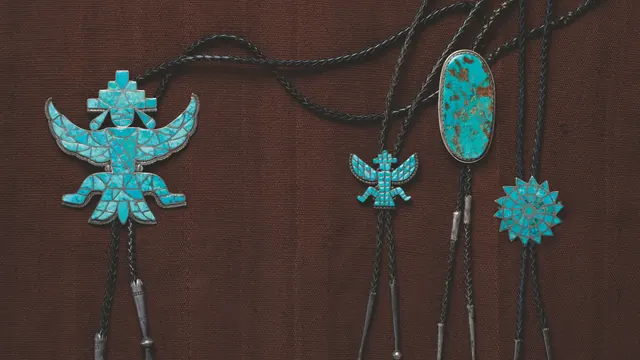
It’s been a big year for western fashion. Whether it’s the runways serving up double denim, or stars like Bella Hadid and Beyoncé embracing rodeo style, there’s been a real shift towards all things cowboy (and cowgirl)-inspired—and part of that movement is the enduring bolo tie.
The history of the bolo tie, which emerged in the Southwest, dates as far back as the 1940s. The piece was heavily popularized by Native American jewelers, especially amongst the Navajo, Hopi, and Zuni tribes; Historically, Indigenous men would wear bandanas around their necks, punctuated with shells or silver conches.
In the decades since, the piece has evolved to be made with leather cords instead—an alternative to the traditional stuffy tie—and worn by cowboys while riding. And now, its stylish legacy is even the subject of a new book: The Rizzoli title, Bolo: Design, Style, Heritage, from author William Matthews, releases today.
Matthews, who is an artist by day, is a longtime bolo wearer and has been collecting them for over forty years—so naturally he was the right author to dive into the bolo’s unique beauty and history. “My father gave me my first bolo,” Matthews writes in the book’s introduction.
“As an artist myself, with much of my life devoted to painting the wild lands and ranches of the West, I see bolos wherever I go. I have searched far and wide to find the most captivating and beautiful ones.”
For longtime fans of the bolo tie, the new book—which includes a foreword by actor and singer Lyle Lovett—serves as a true visual feast. It features photographs of over 500 distinctive versions, some of them never seen or published before. The styles range from vibrant turquoise and coral styles to sleek silver or metal versions, or even bolos made of abalone shells or petrified wood, too.
Given its history, the book zeroes in on Native American artisans who have helped define and popularize the piece over the years. Featuring designs made by Hopi, Navajo, and Zuni artists, the book spans the regions and reflects a striking tapestry of different customs and traditions.
“Native American art is some of the most beautiful work that has ever been created in this country,” writes Matthews. “My goal in producing this book, is to shed light on the amazing bolos that have been developed by the artists at the pueblos, on the reservations and throughout this country.”
Naturally, the book also highlights the many influential figures and celebrities who have proudly rocked the bolo tie, helping to bring it to the mainstream fashion scene. There’s Bob Dylan, for one, who has made bolo ties a signature element of his look.
Or Timothée Chalamet at the 2025 SAG Awards, who fashioned a vintage Cartier Libre Féline watch into a bolo tie—paired with a leather Chrome Hearts suit. Indigenous actors such as Zahn McClarnon are also featured, wearing a polished turquoise-and-silver style.
These are the perfect styling touchpoints to pin onto your mood board—should you be wondering how to rock a bolo yourself.
Better than just an inspiring fashion reference, though, is how the book examines the different ways that a bolo tie can serve as a powerful form of self-expression. For Matthews, the one-of-a-kind jewelry piece is more than just an accessory: It’s the perfect thing to wear when someone wants to proclaim who they are, where they come from, and what they stand for.
“When I wear a bolo, I feel a connection with the artist that created it,” writes Matthews. “These pieces are charged with energy and inspiration, and the hard work necessary to give them life.”