
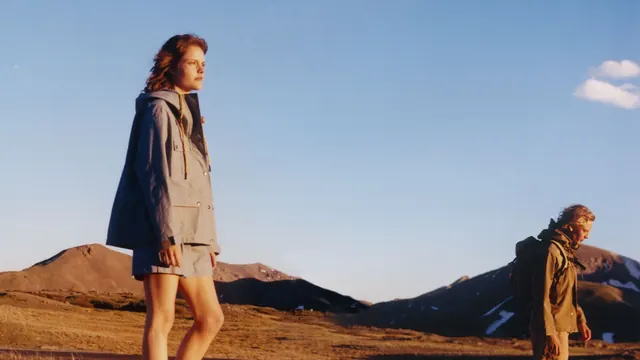
Aspen, Colorado has its modern sporty-chic roots in an unlikely melting pot: Long before Prada, Gucci, and Louis Vuitton set up shop there, it’s where Haight refugees and ski-bum dropouts mixed with cowboys, ranchers and, in more recent decades, real estate barons and financial wizards looking for a high-energy second or third home.
More recently, it’s the site of another interesting meeting of the minds: Moncler’s sporty, alpine-inspired performance line, Moncler Grenoble, and Aspen’s historic 19th-century landmark Hotel Jerome, Auberge Collection. Continuing the recent trend of fashion brands expanding from merely selling things to, you know, providing unique experiences—from hotels, restaurants, and cafes to cultural offerings (Prada Mode and Gucci’s Memoria among them), this new partnership combines a full-spectrum experience at the Jerome with a once-in-a-lifetime hike in the magical terrain surrounding Aspen, led by a guide from the renowned Aspen Center for Environmental Studies (ACES).
I arrived at the Jerome a few weeks ago, just as the aspen trees themselves were beginning to show some color, to find porters and bellhops in full snapped-shirt-and-black-hat cowboy attire. (I didn’t test anybody’s skill with a lariat or a cutting horse—though they were roundly proficient in herding suitcases and bags—but the outfit came off as far more authentic than gimmicky.
You can absolutely still head up the street to buy your own cowboy-for-a-weekend hat at Kemo Sabe along with the rest of the Aspen short-stay crowd, but the vibe here was more functional than flash.)
Inside, the Jerome is nothing less than the beating heart of the town’s social life, so it’s fitting that its epicenter is known as the Living Room. Chase down any glittering bit of juicy gossip in Aspen, and you’ll likely find its origin—whether true or not true— in a late-night gathering here lubricated by one too many Aspen Cruds (it’s not on the menu—but just ask for it).
Full disclosure: This isn’t my first rodeo at the Jerome: I spent a decade working for Hunter S. Thompson, who made the hotel’s J Bar his home away from home, and had the privilege of seeing the place after it was put on the National Register of Historic Places but before it was renovated in the late ’90s and early ’00s.
(My first meeting with Johnny Depp, who wrote the introduction to the oral biography of Hunter that I put together with Jann Wenner, was at the J Bar.) And, yes, I’ll confess to being deeply suspicious of any upgrades to a space and a scene that I’ve always considered to be largely unimprovable, but: I was wrong. If you’ve been to the Chelsea Hotel in New York before and after its recent-ish renovation, you’ll know what I mean: They updated a few things to bring the place up to speed, but they’ve done so while leaving the spirit of the place intact.
The Living Room and the J Bar are still themselves; the rooms are unimpeachably better—more luxurious, more well-appointed—and the service, crucially, is beyond: Ask, and you shall receive; don’t ask, and they’ll likely have already thought of it for you.
I thankfully had a couple days to settle in—both to the Jerome and to Aspen in general—before my hike, and those days were gloriously filled with dining back at the J Bar and in the Jerome’s Prospect restaurant in the hotel’s courtyard; swimming in the Jerome’s chic pool; and ambling about the tiny, magical town.
I met an old friend—DJ Watkins, a legendary local gallerist, author, and troublemaker who functions as something of a bridge between Aspen’s rebel past and its current incarnation—for a coffee in the Jerome’s Felix Roasting Co. DJ runs Fat City Gallery out of a space in the town’s historic Wheeler Opera House, and the gallery’s openings are must-drop-by affairs.
He filled me in on what I’d missed of the town’s wild side since my last visit some years ago, showed me some amazing art (from Johnny, Ralph Steadman, and Hunter, among others), both in his gallery and in his various secret storage facilities tucked around downtown Aspen, and told me of his burgeoning plans to develop an artist’s residence and community on the far side of Aspen mountain. In the evening, I settled in with friends at Bad Harriet, the Jerome’s speakeasy (there’s a fake entrance to it right on Main Street if you know where to look, or just ask someone inside the hotel), which has mind-blowing assortment of cocktails, stellar mixology, and an amazing sound system.
I’ve always found that, while Aspen itself is perennially a fantastic place to visit, after a day or two in town, one wants to ramble a bit: I hopped one of the hotel’s e-bikes and headed north to the Woody Creek Tavern for lunch another day (it’s a 20-30 minute ride on a purpose-built bike path over streams and through wooded groves), and borrowed a Lexus LC500 convertible—a stealthy supercar with a naturally aspirated V-8 that howls—from the Jerome’s fleet for an inspired winding-road sunset cruise to nearby Independence Pass and its jaw-dropping mountain views.
And then, on the appointed day, I suited up in my Moncler Grenoble hiking pants, trail-running shoes, and utility hiking vest. (Didn’t bring your own?
You’re in luck: The local boutique is a five-minute walk from the hotel, and they’d be happy to set up a private appointment.) I was served an inspired feast for breakfast at the Jerome—where I was also given my custom Hotel Jerome Treks by Moncler Grenoble kit—limited to 100 editions, or 100 hikes, depending on how you’re measuring this sort of thing—replete with thermos, hat, a field notebook, and some custom patches; and chauffeured from the Jerome a dozen or miles or so into the Castle Creek Valley, where I met Charlie Robinson of ACES.
Charlie made sure I had the usual safety guards in place—water, hat, sunscreen, check check check—offered to tote my water for me (thanks), and offered me a choice: an easy, two-hour hike on the River Run trail, or a fairly grueling but epic five- or six-hour hike, largely uphill, on the renowned Cathedral Lake trail. While my heart was feeling epic, my legs, I feared, were more trained for the River Run (I had also been a bit sleepless, perhaps from the effects of nearly 8,000 feet of altitude—drink lots of water!)... at any rate, off we went.
What followed were a couple of the most amiable, sublime, and well-informed hours I’ve ever spent in the wild. Charlie was an ideal guide—knowing exactly when to unpack some essential information about whatever we were seeing, and when to shut up and let the surroundings speak for themselves.
We wandered through the still-standing buildings (an opera house, a saloon, a rooming house) of an abandoned ghost town, Ashcroft, which existed for only a few years during the area’s late 19th century silver and gold mining boom; we wandered through sagebrush and spruce, fir and willows and, of course, aspens.
We spotted a tiny gray bird—North America’s only aquatic songbird, as we soon learned. “It's called an American Dipper,” Charlie said. “You'll see them on the rocks in the river, where they live all year long and dive and hunt for fish.”
We passed these tall, crazy, ornate flowering plants called green gentials, or monument flames. “They spend between 20 and 80 years building a big tap root, storing a lot of energy,” Charlie said, “and based on some environmental cue that we don't really know, they will bloom once in their lifespan and use all of the energy in that bowling ball-size tap root, and they have hundreds of flowers.”
We spotted what turned out to be old piles of mine tailings from the silver and gold rush, which Charlie brought vividly to life. “It's just unbelievable that with no trails, no modern gear, these miners were packing out mules and literally going up into these alpine zones and looking for their fortune, their future.
They didn't have dynamite, but they had packed powder, and they would pound these little holes in a spiral into the face of the cliff, pack it with powder, blow it up, and then haul the tailings out. Tied in with that story, though, is the forced removal of the Ute people, who were master horsemen, and who would come up here and hunt elk in the summer.
And over a span of 10, 20 years, there were basically smear campaigns done by the government, which moved them to places where they didn’t really want to go after broken treaty after broken treaty.”
Elk still lived all around us, apparently, though we didn’t see any on our hike. (There were bears running around downtown Aspen, though, just before and just after our visit.) “If I'm an elk and I live here,” Charlie told me, “I'm staying safe from predators and staying cool in the summer by going into the evergreen forest during the day—and then, during the morning or the evening, coming down to the other side of the valley into the aspen groves where there's lush undergrowth and plenty of food.
It's like the evergreen trees are the hotel, and the all-you-can-eat buffet is the aspen grove.”
We finished our hike with a sumptuous picnic prepared by the chef at the Hotel Jerome back at the wooden cabin where we had begun—a place called Toklat, built in the summer of 1948 by Stuart and Isabel Mace, forward-thinking visionaries who are largely to thank for the environmental focus of much of early Aspen’s consciousness in the latter half of the 20th century. The Maces were invited to the area by Walter and Elizabeth Paepcke, along with writers and philosophers and all kinds of people who were acclaimed in their various fields, to create what Charlie calls “this Aspen idea.”
“Isabel Mace was super into natural food and would have been on the pre-order list for Silent Spring by Rachel Carson [a landmark work of environmental science],” Charlie said. “They were very progressive people—Stuart was really well known for driving down Castle Creek Road to Aspen City Council meetings and saying, ‘Well, hey, I'm here to speak for nature.
The beavers can't talk, and the trees can't see, and the river only flows in one direction. I’m here to represent the parts of our community that are not in this room right now, which is all the living things around here.’”
Far from a mere hike, this had been at once a magical, sense-stirring escape; an easygoing natural history lesson; and a small immersion into the breathtaking story of a place—Aspen, of course, but what surrounds Aspen as well—that has long been far, far more than meets the eye.
I thought about all this—am still thinking about it, in fact—when I got back to the Jerome for my appointment at its Yarrow Spa. While I may not have gone for the epic hike, a massage—replete with alpine botanicals gathered from the area—was absolutely what was needed.
So, yeah: Go to Aspen. Get your cowboy on, or your cowboy hat. But if you want to feel a part of the place and its astounding singularity, stay at the Jerome, sign on for the Moncler hike—and tip your hat back to the cowboys on your way out.