
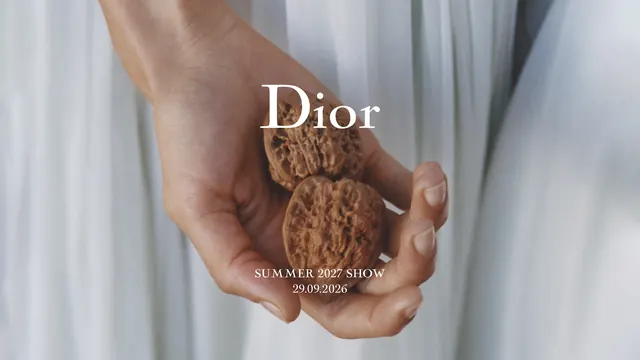
Paris Fashion Week is officially underway, and later this afternoon all eyes will turn to Dior , where Jonathan Anderson is set to unveil his Spring/Summer 2027 womenswear collection. The Creative Director has already offered the fashion crowd an unusually tactile preview, sending guests custom grey boxes containing a pair of knobbly walnuts.
The unexpected invitation seems to reference traditional Chinese Wenwan walnuts (文玩核桃) which are held and rotated continuously in one palm for mindfulness, longevity and good fortune. If held and slowly rotated in the palm, their deeply ridged surfaces will gradually develop a smoother patina through years of handling.
The invitation feels particularly pointed given Anderson’s own teaser for the collection, which reads: “Long before a tree spreads its branches to the sky, the nut holds the knowledge of its form.” Whether taken as a meditation on time, materiality or simply the designer’s penchant for the unexpected, the message appears to place nature and tactile craft at the centre of today’s outing, asking its audience to consider an object not as something instantly consumed, but something that changes through touch, patience and use.
Anderson’s digital previews only deepen the intrigue, throwing open the fitting room to reveal a world of eccentric details and purposely offbeat material choices. His latest glimpses at the collection are populated by mismatched buttons, jewel-like accessories and whimsical avian motifs, while a particularly charming swan-shaped minaudière and fruit charms inhabited by tiny worms suggest that his longstanding fascination with the animal kingdom is finding a new home within the Dior universe.
Elsewhere, floral-print heels and fluid draping introduce a softer, almost storybook quality, setting up a collection that appears to move freely between the romantic, the surreal and the delightfully strange.
Dior’s Spring/Summer 2027 ready-to-wear collection will be unveiled live from Paris today at 3pm CET. The show can be streamed via Dior’s official YouTube channel and the house’s digital player. Watch the show here .
photography. courtesy of Dior words. Gennaro Costanzo
Frederique Constant, the Classics Moneta Handwinding Watch.
Frederique Constant is giving the Classics Moneta a mechanical makeover. First introduced in 2024, the collection has entered a new phase with the arrival of the Classics Moneta Handwinding — its first model to feature a mechanical movement. The time-only release pairs a 38.5 mm case with a hand-wound calibre developed by La Joux-Perret and customised exclusively for the Geneva-based Maison.
Produced in a limited run of just 999 pieces, the watch has also secured a shortlist spot in the Challenge category at the 2026 Grand Prix d’Horlogerie de Genève (GPHG), alongside the Classic Worldtimer Manufacture , which has been selected for the Petite Aiguille category.
The new FC-435 movement is visible through a sapphire caseback, where Côtes de Genève decoration and Frederique Constant’s crest provide a considered finish. Beating at a frequency of 4 Hz, the calibre delivers a 63-hour power reserve. Its manual-wind configuration dispenses with an oscillating weight, helping preserve the Moneta’s relatively slim profile while reinforcing its vintage-inspired character.
That neo-retro aesthetic is most apparent on the dial, which features a smoked salmon gradient that deepens to black around the edges. Mirror-polished applied hour markers sit alongside central dauphine hands and a small-seconds display at 6 o’clock, drawing directly on the visual language of 1950s watchmaking. The composition is completed by a black small-scale alligator leather strap, chosen for its supple feel and lightly patinated appearance.
The defining detail of the Moneta, meanwhile, remains tucked inside the case. Its inner rehaut is subtly sculpted with fine fluting inspired by the ridged edge of a coin — the feature that gives the collection its name and distinguishes its otherwise classical proportions.
Meanwhile, the Classic Worldtimer Manufacture represents a different side of the Maison’s mechanical offering, combining a 40 mm case with the in-house FC-719 calibre. The automatic movement extends the power reserve to 72 hours and drives a Worldtimer complication displaying all 24 reference time zones simultaneously, with a two-tone disc distinguishing day from night across the world map dial.
For Frederique Constant, the two nominations underline the breadth of its current approach. The Moneta brings a finely finished mechanical calibre to an accessible point within the Challenge category, while the Worldtimer showcases the Manufacture’s capacity to develop and assemble its own calibre and complications. The winners of the 2026 GPHG will be announced at the official awards ceremony on 7 November.
The new Classics Moneta Handwinding is now available globally online and in boutiques. Discover more here .
photography. courtesy of Frederique Constant words. Gennaro Costanzo
Prada Uomo, Prada Galleria Vittorio Emanuele II.
Right after Milan Fashion Week, Prada is reclaiming its historic Milanese birthplace with a monumental eight-storey takeover inside the Galleria Vittorio Emanuele II, christened simply ‘ Prada Galleria ’. Uniting retail, historic café culture, contemporary art and deep archival heritage under one glass-domed roof, the project expands upon the 19th-century shopping arcade where Fratelli Prada first opened its doors in 1913.
Guided by Miuccia Prada, the complex links both flanks of the arcade’s central octagon through a newly constructed subterranean passage. Dubbed the ‘Passaggio Segreto’, the underground tunnel physically joins the expanded Prada Donna and Uomo boutiques, operating as a hidden gallery filled with archival specimens and early design experiments. Below street level, the expanded women’s store nearly doubles its display space, housing travel, beauty and home collections alongside restored period murals.
Marchesi 1824, Prada Galleria Vittorio Emanuele II.
Pradasphere, Prada Galleria Vittorio Emanuele II.
Above the retail floors, visitors can pause for espresso and pastries at Marchesi 1824 , Milan’s iconic historic pasticceria, before ascending to the piano nobile. Here, ‘Pradasphere’ debuts as the brand’s first permanent museum-scale exhibition. Having previously toured London, Hong Kong and Shanghai, the archive now settles permanently in Milan, gathering over a century’s worth of garments, architectural scale models and film collaborations into a living timeline.
Ascending into the upper levels shifts the mood toward private hospitality and bespoke commerce. The second floor houses the ‘Studio’, an appointment-only space designed for tailored fittings, which opens directly into the ‘Appartamento’.
Designed to mirror an opulent 18th-century residence, the invitation-only space showcases an exhibition curated by German photographer Andreas Gursky , setting contemporary art against antique Italian furniture and views of the arcade’s monumental mosaics. Crowning the entire complex at roof level, the ‘Osservatorio Fondazione Prada’ serves as an open research lab dedicated to visual culture and digital media, currently hosting ‘The Island’, a solo exhibition by artist Hito Steyerl .
Prada Donna, Prada Galleria Vittorio Emanuele II.
Osservatorio Fondazione Prada, ‘The Island’, solo exhibition by Hito Steyerl.
Prada views the house’s past as “an accumulation of ideas bound by intuition, collaboration and intellectual exchange,” and Prada Galleria brings that exact philosophy to life. Find out more here .
photography. courtesy of Prada words. Gennaro Costanzo
If you’re walking past an Hermès boutique in Switzerland this autumn, you might want to look up from your phone — the house has lifted off, launching its visual vocabulary into orbit. For its Autumn/Winter 2026 seasonal window displays, Hermès Switzerland has partnered with Lausanne-based design studio Panter&Tourron to rework the Maison’s annual theme, L’appel du large, into ‘Space Oddity’.
The installation draws on the way generations have pictured space before anyone could actually visit it. The fantastical travels of Jules Verne, Moebius, the optimism of the Space Age and retro-futurist imagery all feed into a galaxy where spacecraft become characters and distant planets turn into stages for imagined adventures.
Across the 18 windows, captured across the Zurich, Geneva and Lausanne flagships, the scenes change from one imagined story to another: a first landing, an expedition across unfamiliar terrain, a departure into the unknown or an encounter with a distant constellation.
Suspended inside the windows is a fleet of strange flying objects that initially resemble satellites, rockets, orbital stations and solar sails. Look closer and the designs begin to reveal a distinctly Hermès identity: a giant H becomes a spacecraft, a horse’s head turns into a satellite and stirrups and harnesses become celestial vehicles.
Hermès Lausanne Store by Jagoda Wisniewska.
The sculptures are built around the same tension between engineering and fantasy. Panter&Tourron took cues from deployable aerospace structures, but also from the lightweight construction of kites, sails and tensile forms.
Solar sails became a particularly fitting reference, using sunlight itself to generate propulsion and giving the installation a real technological connection beneath all the fantasy. Free from gravity, delicate mobiles slowly rotate overhead next to minimal spherical lights that act as miniature suns, establishing invisible orbits within each frame.
The silk scarves, leather bags and enamel jewellery act as active participants within these mini-galaxies. Suede loafers and Birkins double as alien geological formations on brightly coloured planets, while leather goods stand in as mysterious extraterrestrial artefacts discovered on uncharted soil.
The collaboration continues a relationship between Hermès Switzerland and Panter&Tourron that stretches back to the studio’s earlier window projects for the Maison. Their previous work included ‘Zoomorphisme’, which filled the Geneva and Zurich windows with colourful creatures interacting with Hermès objects, and ‘Jungle Jalousie’ in Lausanne, where tropical vegetation, shadows and movement became part of the display.
photography. courtesy of Alicia Dubuis , Dejan Jovanovic and Jagoda Wisniewska for Hermès words. Gennaro Costanzo