
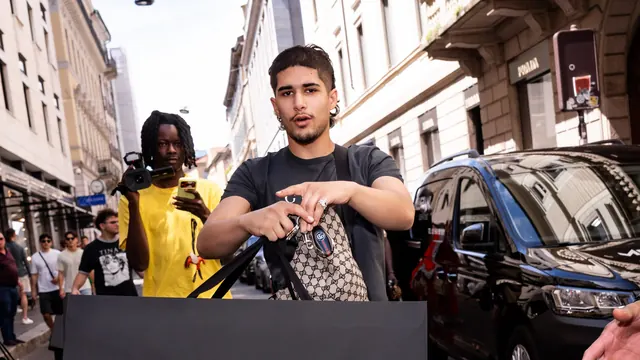
This season, fashion has been feeling a little messy, embracing the chaos and lack of decorum that so often defines youth. Prada leant into skimpy bras, nu-rave neons, and mismatched styling.
Glenn Martens’s swansong show for Diesel was headlined by snogging actors recreating one-night stands in the risers and a collection of shredded looks. Even Burberry took a tarnished approach to its fabrications while calling on a swaggering Central Cee to walk the runway in sagged baggy jeans — hoodie up.
So much for the luxury polish.
How does this turn to the imperfections of youth style and subcultures square with luxury price hikes and reduced luxury spending among Gen Z shoppers? Indeed, consumer sentiment is shaky.
Late last year, in a Vogue Business study, several Gen Zs shared that they consider spending large amounts of money on luxury distasteful and don’t deem new luxury goods as worth the cost. Instead, the thrill of securing an IYKYK find from a vintage marketplace provides their closet with more cultural capital than a pricey brand-new purchase.
For The New York Times, Marni’s latest collection was exemplary of this price-audience dissonance, proposing “Gen Z chaos” despite the couture cost.
More broadly, taste has shifted. Three years ago, quiet luxury were the words on every buyer, editor, and trend forecaster’s lips.
Fast forward, and that trend has resolutely passed, remaining only at the fashion houses that had always done it: Hermès, Brunello Cucinelli, The Row. This shift toward edgy runway propositions that can be readily achieved on a budget through savvy styling, super-fakes, or vintage purchases seems — at first glance — a risky move, particularly if brands are expecting return on investment.
By doing this, fashion houses are positioning themselves as inversely aspirational, pulling on youth tribes for inspiration and attempting to sell it back to them. The value that the brands need to communicate to consumers is less obvious.
Prada’s Fall/Winter 2026 women’s collection — characterized by soiled shirt cuffs, frayed hems, and loose threads — seemed more attuned to the thrifted, cigarette-snagged fashion students than it did jet-setter wardrobes. Equally, Demna’s Gucci has been highly Gen Z led, reliant on runway cameos from underground rappers Fakemink and Nettspend, as well as It-girls Gabbriette and Amelia Gray with smudged, smokey eye makeup.
The clothes, pundits comment, look borderline fake, chiming with internet irony, rather than traditional signifiers of quality.
Where brands were once the center of culture, today, young consumers are, argues Bayla Metzger, Archrival’s senior editor for thought leadership. She believes brands are right to be inspired.
“While the aesthetics rising right now are messy and confusing, they reflect the psychological state of the next generation,” she says. “Young people face an uncertain future.
They’ve heard that AI might wipe out humanity in the next 10 years, and they’re contending with what that means for them.” The result, according to Metzger: Gen Zs balance their drive and ambitions with a more nihilistic worldview, reflected in a return to tanning and — as the runways made clear — smoking.
For brands, the roadmap ahead is complex. Luxury has stabilized, but its return to growth in 2026 will be slow, Bain predicted.
Gen Z — despite brand disloyalty — is projected to reach a spending power of $12 trillion globally by 2030, according to NielsenIQ. The firm also reported that Gen Z will lead affluent spending growth, reaching $12.4 trillion in 2036, an 8.7% compound annual growth rate (CAGR).
Gen Alpha should follow just behind, with a CAGR of 8.1%.
To this point, Gen Z is forecast to account for 25-30% of luxury purchases in the US by 2030, per trend forecasters WGSN. “Associating with figures they look up to can build aspiration and brand affinity even if that doesn’t translate into immediate sales,” says Mia Jacobs, WGSN’s senior strategist for youth fashion. “That longer term relationship shouldn’t be underestimated.”
Shifting expectations
Youth culture isn’t new to fashion mood boards. Style tribes, music, clothes, attitude — these markers have appeared on runways for decades.
Marc Jacobs’s infamous SS93 grunge-inspired collection for Perry Ellis is one of several examples. Raf Simons, Prada’s co-creative director, is also a seasoned subculturalist and youth obsessive.
His eponymous collections featured Haçienda-affiliated Peter Saville’s graphic designs for bands including Joy Division (FW03), skinhead-style MA1 jackets (FW01), and artist Mark Leckey’s cult classic rave film, Fiorucci Made Me Hardcore (SS07). Similarly, Hedi Slimane was always partial to casting indie boy band members during his Dior tenure (2000-2007).
But what worked before won’t work today in creating something newly desirable for a generation that consumes fashion differently. “The shift is not only what Gen Z are wearing, but how they’re wearing it — new codes, new gestures,” says luxury strategist Richard Gray. “The battered thing with the expensive thing, the Vinted find, and the piece that doesn’t quite belong. It’s a bit odd and wrong — a bit anti-algorithm.”
Gray claims that perfection has lost its luster in luxury, and this is mapping onto the ways brands storytell in their collections. “There’s a sense the clothes look better because nobody appears to have tried too hard,” he explains. “That instinct is more compelling than simply declaring a subculture back and reproducing the uniform.”
As such, brand references to youth culture can no longer be an occasional nod or a single show theme. Rather, they must feel organic and part of the brand’s broader storytelling plan.
It’s not just a nice-to-have. “Luxury, like other culture industries, needs to have cultural relevancy in order to exercise its soft power,” says brand advisor Ana Andjelic.
For her, luxury cannot command high prices or remain aspirational without it. “A person with spending power tends to buy a trendy luxury item over a trendy item from a brand with less cultural capital.”
What’s in it for brands?
There’s good reason for brands to invest in subculture, messy aesthetics, and youth codes. Provided it’s well executed, it could even trump quiet luxury. “In today’s accelerated cycle of collections, content and culture, restraint alone is increasingly difficult to turn into cultural momentum,” says Tanner Graham, co-founder and CEO of creative agency General Idea. “Buzz requires tension, and increasingly that tension comes from engaging with the provocation, codes, and contradictions emerging from youth subcultures.”
According to research from GWI, Gen Z is more likely than the average consumer to want luxury brands to be aspirational, artistic, fun, innovative, and bold. For comparison, baby boomers associate luxury brands with qualities of timelessness, sophistication, and elegance. Essentially, younger consumers engage with luxury as a mode of self-expression, while older consumers look to time-tested features.
“This is in line with what we’d expect from those groups at their stage of life,” says Chris Beer, a senior data journalist at GWI. The challenge, it seems, is that what’s deemed bold changes at an unprecedented pace, proliferated and quickly flattened by the internet.
Where before, a luxury brand could tap into a youth tribe — say, New Romanticism, by mimicking the wares — today’s subcultures spawn and disappear often before the brands can react. “We know that younger consumers want luxury to feel experimental, expressive — and maybe a little transgressive — but the challenge for brands is staying close enough to the audience to figure out how those qualities are currently expressed.”
Getting it right
The stakes are high. Younger audiences are better versed in recognizing when a style reference feels observed rather than lived. “The moment the strategy becomes visible, the magic has gone,” says Gray. “Vibes become marketing, and that’s just embarrassing.”
That’s not to say consumers aren’t convinced by contemporary attempts to court the youth. In 2025, 16 to 25-year-olds represented 36% of sales at Diesel, thanks to Martens’s whack-a-doodle world-building approach.
Insiders are also convinced by some of the youth-led plays going on. “I think Demna’s hit a smart middle ground.
There’s that undercurrent of irony to everything he does, which feels representative of the tone of the internet,” says Bertie Brandes, an editor and scriptwriter of luxury brands. “A lot of his Gucci stuff has been designed to look like knock-offs — a green light for kids to go out and get the Demna Gucci look however they can.”
For Brandes, in 2026, youth culture and being online are basically the same thing, which extends across age groups. Recently, she developed a very online copywriting strategy for Guess Jeans, captioning a series of selfies with existential, sad post-inspired musings.
“It connected to something of a movement that I think is coming from music right now: lo-fi, still deeply ironic but somehow so earnest at the same time,” she says. “Brand names are really losing their status, the varnish is chipping away, and I think that’s a good thing.” She also mentions Guess Jeans’s accompanying activation with electronic pop duo the Femcels, held during London Fashion Week as a free, IRL event.
“The brand hosting it is almost irrelevant, as it should be, when the culture is real.”
Brands wanting to capitalize on youth culture need to build trust with young consumers before they can begin selling high-price personal luxury goods to them. That might mean developing entry-level products for younger consumers that tap into scenes and music cultures without relying on the obvious route of beauty launches and scene-y guestlist curation.
“I do think aligning with relevant talent is one way, but it needs to go beyond inviting someone to a show,” says Ursula founder and brand strategist Emma Hope Allwood. She suggests collaborating on a music video or a “tourdrobe”, as well as hosting free concerts for fans with cheaper merch collections. “Luxury fashion relies on an emotional connection,” she adds. “Brands would be wise to build that sentiment early.”