
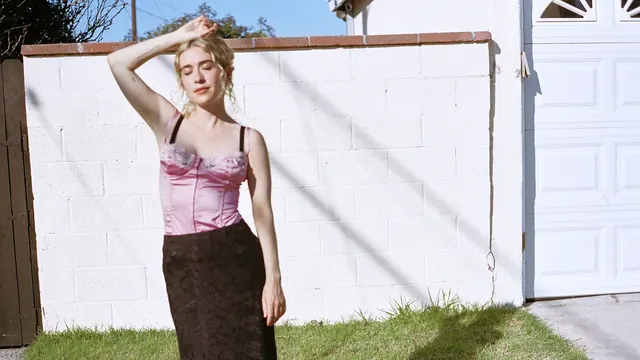
I meet Sabrina Teitelbaum on a crisp, almost-fall day in east London, a meteorologically confused moment that has called for the first outing of her new vintage Yohji Yamamoto trench. “All the girlies are on the Carolyn Bessette-Kennedy grind now,” she says, “so we have to work a bit harder to get the good stuff.” But this sleek and inky jacket is, indeed, the good stuff.
(Later, we’ll part ways after sharing a list of vintage dealers along her touring map.)
Teitelbaum is two weeks out from releasing Violins, her third album as Blondshell, and change—what to seek out, what to shed, how to recognize yourself as you move between versions—is on her mind. Since her self-titled debut arrived in 2023, followed by If You Asked for a Picture in 2025, she has preferred to work quickly.
“I feel like each year things change so much and that makes me feel like a bit of a different artist every time that happens,” the 29-year-old tells me. “I don’t like to have music out that doesn’t feel like it represents who I am in this exact moment.”
Most of Violins was written while Teitelbaum was touring last year, before she and longtime producer Yves Rothman went into the studio in Los Angeles in January. By April, it was finished: 11 songs that feel grander, sharper, and more sonically expansive than ever; the edges are sharper now, too.
Where the guitars on her first two records could be “washy and shoegazy,” she says, this time she wanted them drier and more angular, looking to Gang of Four, Suede, and The Replacements. Leonard Cohen appears elsewhere as a lyrical lodestar; a poem of his was the jumping-off point for “Two Fried.”
Yet ask Teitelbaum what she was trying to say with the album and you encounter something close to resistance. She doesn’t begin records with theses.
She generally doesn’t understand their thematic architecture until the music is finished and conversations about photography, artwork, and videos force her to take a wider view. “For me as an artist, I’m never trying to do anything,” she says.
“I’m never trying to get a certain message across or a certain feeling across.” Instead, songs are where knotty subjects end up when she can’t quite put them anywhere else. “I write about things that are difficult for me to talk about in my everyday life.
This is sort of my place to talk about those things and I write about things that are painful to me…All of my favorite songs are painful.”
And there is plenty of pain on Violins. There is also beauty, sex, complicated friendship, faith cleaved from religion, and the strange moral vertigo of experiencing an ordinary, pleasant day while images of extraordinary violence arrive through the rectangle in your hand.
That dissonance gave Teitelbaum “Lucky,” one of the first songs she wrote for the record after arriving in Dublin a day before going on tour. “There was just a lot of really violent imagery,” she remembers.
“If you listen to the news or even Instagram, there’s so much violence, and it’s so overwhelming.” At the same time, she was somewhere new, “just sort of going about your day and drinking coffee and eating breakfast,” and struggling to reconcile those small pleasures with everything else she was seeing. Domestic vignettes of lemon cake in local cafes sit alongside reflections of a world on fire.
That willingness not to resolve everything may be the biggest difference between this Blondshell record and the two that came before it. Paradoxically, becoming less literal in her writing and allowing her vivid and abstract dreams to come in has made her capable of being far more direct.
Early on, she says, “I really wanted to be understood.” She can now identify places on her first records where that desire led her to explain more than was necessary—not that she regrets them. She simply trusts herself, and her audience, differently now.
“This time I feel a bit more like, ‘I hope you can meet me where I am, and if you don’t, maybe you will another day.’”
The distinction runs through Violins. Previous Blondshell songs often approached questions of power, addiction, or the body through romantic relationships.
Here, those concerns are allowed to exist without that framework; imagery of periods, food, sex, and flesh recur. (On “New Age Trojan Horse,” she takes aim at supposedly enlightened men who remain squeamish about menstruation.) “I feel, so much, like I physically live in my head,” she says.
“Learning how to live in all of my limbs and my whole body is something that I’ve been kind of focused on recently.” Healing is a word Teitelbaum says she once found harder to use. She had associated talking about trauma with somehow failing at being “normal and functional”; now, she considers the process itself “extremely normal.” Becoming more present in her body has even started to assume the shape of faith.
“I’m not religious and I don’t really connect to organized religion,” she explains. “Learning how to live in your body isn’t something that I grew up doing, and learning that feels most akin to faith for me. That’s something I believe in, that I have to keep believing in.”
On “Sea Legs,” one of the songs written at the very end of recording, Teitelbaum circles spirituality more explicitly. She describes it as “a list of things that I think are arguments for the presence of God,” although those arguments eventually collapse into the earthly things themselves: rain, harmony, another person “kind of doing someone else a favor,” as she sings over lush, lightning-flash layers of guitars.
“That word has been a really big sort of block for me for what a spiritual life could be,” she says of God. “It’s more of a curiosity… for me, it felt like, What’s over here? I’m coming to look.”
The body is a central motif and a tool she continues to grapple with. “My relationship to my voice is one of the most complicated things in my life,” she says.
Teitelbaum sang constantly as a child and was praised for it enough that it got tangled up with her identity. “It was also kind of my life support when I was feeling bad,” there for her during intense personal loss, she says.
The difficulty is that this particular instrument changes according to hormones, environment, weather, sleep, hydration, and, sometimes, for reasons beyond explanation. For someone who likes control, standing in front of a crowd with that degree of biological unpredictability can be unnerving.
So, she is consciously attempting to stop demanding perfection from it. “Recently I’ve been trying to see that unknown, that factor of so much unknown, as an exciting thing and a place for me to be able to connect to people,” Teitelbaum says.
Instead of walking onstage thinking something could go wrong, she is trying to think: none of us knows exactly what is going to happen. That philosophy could describe Violins as a whole.
Even Teitelbaum’s collaboration with Rothman, now three albums deep, thrives on knowing when and when not to surrender control. She generally arrives with her songs fully formed.
He is one of the very few people permitted to question a lyric—and even then his success rate is questionable. When Rothman objected to the phrase “shrimp cocktail” in one song, Teitelbaum refused to budge.
“I was like, ‘But that’s my order. I love shrimp cocktail.’ So I kept it.”
Outside the studio, she has been reading—Valley of the Dolls, Madonna in a Fur Coat, the Irish novel Sunburn—and deliberately getting herself away from screens. She drives to Malibu despite living nowhere near it, sees friends and family, journals, and tries to cook.
“I’m a terrible cook,” she says. “I’m getting better.” She likes the simple physicality of it: working with her hands, doing something that exists away from the endless abstractions of a life online.
There is another transition approaching, too. Teitelbaum is 29 and nearing 30. “Turning 30, I think, comes with a lot for women, especially women in entertainment, and the value of you based on your body and how that value changes when you’re not in your 20s.” She has thought about it, she says, but it doesn’t weigh especially heavily.
Why would it? “I feel happier than I have ever been,” she says. “My life feels more stable than it has ever been.” Given the choice between youth and accumulating self-knowledge, there is no contest. “I would make the trade any day to continue to be 29, 30, 31, et cetera, and know myself more. I don’t ever want to be 22 again. Ever.”
In December, Blondshell will take Violins on tour, beginning in Amsterdam and finishing in Dublin—that city where one of its earliest songs first appeared. Teitelbaum has already begun introducing much of the record live, and she loves the peculiar alertness that comes before songs settle into muscle memory. “I’m enjoying this push to be super present,” she says.
Confidence comes not because uncertainty has been cast out, but because Teitelbaum is becoming increasingly willing to inhabit it. “We’re not really meant to be standing in front of people and not sure what’s going to come out,” she muses. “But I think it’s what makes me so brave, so I’ll continue to do that. I think it’s going to make me really strong.”
Violins is out now via Partisan Records