
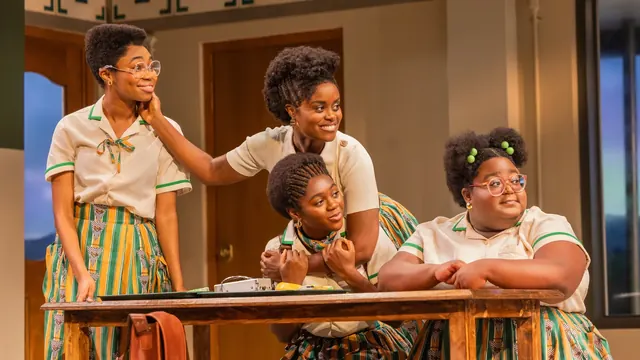
“I think our mean girls would probably eat Regina George for breakfast, lunch, and dinner,” Jocelyn Bioh, author of School Girls; Or, the African Mean Girls Play, tells Vogue over Zoom in mid-September.
School Girls, which first played off-Broadway in 2017 and will reopen at the Samuel J Friedman Theatre on September 28, centers a lively crew of boarding schoolers as they prepare for the 1986 Miss Ghana pageant. The group’s leader, Paulina (Denée Benton), harbors high hopes of snagging the crown.
That is, until Ericka (Jasmine Amy Rogers), a new girl with lighter skin and a finger on the pulse of American coolness, relocates from the United States, upending the social hierarchy. What follows is a vibrant and energetic commentary on class, colorism, and character.
School Girls is set at Ghana’s Aburi Girls Boarding School, the same institution Bioh’s mother attended in the 1980s. Private family lore became public in 2017, when Bioh forgot to erase a lighthearted playwright’s note from an early draft, accidentally outing her mother as a former mean girl. “She was like, ‘You told The New York Times I was mean?!’” remembers Bioh. “I was like, ‘Oh my God.’”
Bioh herself was a boarder at Pennsylvania’s Milton Hershey School, which enrolls more students of color than most other private academies in the US. “[My mother and I] both had this very unique experience of going to boarding school with other people who looked like us…I always knew I wanted to write about that,” she says.
Her imagination was also piqued by the drama inherent to living, unsupervised, with other teen girls. “Your parents aren’t around; it can become Lord of the Flies if you let it.”
To bring this revival to life, Bioh teamed up with director Whitney White, with whom she also worked on her play Jaja’s African Hair Braiding. To School Girls, White brought her own college experience as a classically trained singer and rock vocalist trying to find her niche.
“Northwestern was extremely cliquey at the time,” says White. “You could never be enough of anything to please any group. And I think that that’s been something that’s really defined my career. It’s like, Okay, I guess I’m just going to have to make my own way.”
A knack for defying categorization is something Bioh and White—whose pool of talents includes singing, composing, acting, writing, and directing—share. “There’s different facets of artistry that I think we’re also bringing into [our plays],” says Bioh. “We just have an eye on everything.”
While working together, the pair take a multimedia approach to communication. “We love a good comedic meme,” says White. “There’s DMs, voice memos, lots of evidence. If the government ever took our phones, they would discover we’re not criminals, but we definitely share over every medium possible.”
First bringing School Girls to an American audience in the 2010s wasn’t easy. “People did not understand the concept of African comedy,” says Bioh.
She added the subtitle, “Or, The African Mean Girls Play,” to contextualize the work, intending to remove it later. “Sometimes I regret it and sometimes I don’t,” says Bioh.
“I only regret it when people come up to me and say, ‘I love Mean Girls.’ And I’m like, ‘Me too, but I’m not Tina Fey.’”
Some of the humor in School Girls revolves around Paulina torturing a member of her squad, Nana (Erin Morton), over her weight. “Are you determined to look like a cow?” she asks Nana in front of the other girls during the play’s opening scene.
And, later, while privately blackmailing her: “I know you don’t want to be sent back to your mother with the way she likes to starve you. I mean, I can’t blame her.
I’d be ashamed if I had a fat ass daughter too.”
Ten years ago, audiences were primed to laugh at this kind of punching down. “This time around, I can feel that the audience is really, really on [Nana’s] side,” says Bioh. “[It] warms my little heart that we can see beauty in all people now that we maybe couldn’t a decade ago.”
A more timid playwright might have worried they would lose their audience over the anachronistic humor, or Paulina’s cruelty. Not Bioh. “It didn’t matter whether [the audience] liked her or not,” she says. “They really understood her and her journey by the end of the play. That was the most important thing to me...Comedy is just a funny way of being serious, and I think we really land that.”
While the story starts with a group of girls jostling for provincial power, the stakes grow exponentially when Eloise Amponsah (Patina Miller), the former Miss Ghana 1976, arrives. As she lays bare her determination to recruit a candidate who can not only win Miss Ghana, but also go on to compete for Miss Universe, the girls become painfully aware of the biases and demands of a world external to their school and country.
“Our big, bad mean girl is not just dealing with groupthink politics,” says White. “She’s actually dealing with…Why does my color affect my value in the world?
By the end of this play, this entire group of women—their understanding of where they are in the world and where the world places them and values them—is changed. And I think that that is why, maybe lovingly, we’re saying she could eat Regina George for lunch.
Because some of the things that she’s dealing with are big, big, big obstacles. Not just, Do you like me?
It’s, Does the world see me?”