
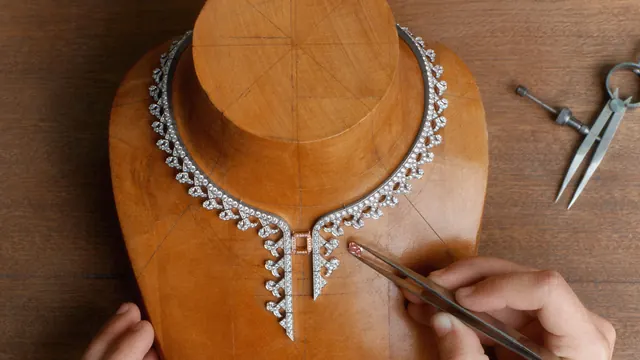
The latest stop for a De Beers high jewelry launch? London Fashion Week.
Vibrations, the jeweler’s latest collection, dropped in the British capital on September 17, during day two of London Fashion Week, marked by an evening that spanned dinner, a private dance performance by Aishwarya Raut and choreographed by Benoit Swan Pouffer, a speech by South African and British poet Thembe Mvula, and appointments with VICs. The move marks a milestone in De Beers London’s rebranding journey.
“I’m extremely proud, because it really shows the whole identity and the way we want to express it in the place which is our creative home,” says CEO Emmanuelle Nodale.
The new collection is punctuated by various De Beers hallmarks: creative concepts inspired by its four mining countries (Botswana, South Africa, Namibia, and Canada); diamond colors spanning pink, green and blue tones (also available as loose stones); the use of rough diamonds; and most importantly, the introduction of its new cabochon cut — the smooth, domed shape often used for colored gemstones.
The significance of the cut lies in the intricacy of the cutting and finishing process, which the CEO says is something only De Beers can pull off, thanks to its direct mine access. “No other brand will be able to do this, and that’s why we want to make cabochon cuts one of our signatures alongside rough diamonds,” says Nodale.
Following a careful study of the natural stone, diamonds are traditionally cut in shapes that both conceal imperfections and minimize waste. The new cabochon cut, however, requires an additional diamond-powdered ceramic disc to create a smooth, homogeneous surface by removing more of the rough diamond material — a lengthier process that’s less tolerant of flaws and creates more waste.
With fewer than 0.5% of diamonds meeting the criteria for color, clarity, natural shape and crystal structure to be turned into cabochons, the shape doesn’t typically make economic sense for diamonds. But as Nodale explains, De Beers can directly select the stones naturally shaped for maximum yields as cabochons, enabling the innovation to place it ahead of competitors in a burgeoning jewelry market.
In Vibrations, cabochons feature in the jeweler’s Undulation set — comprising a necklace, two rings, a bracelet, and two pairs of earrings — evoking the water droplets that appear along the Okavango River in southern Africa, which forms the world’s largest inland delta. The rounded cuts create a lively and dynamic contrast to more classic shapes, as well as very rare rough green diamonds.
For the very first time, the high jewelry collection also includes diamonds sourced via GemFair, a De Beers Group program that supports artisanal miners by providing traceability tools and support for the development of their communities. The selected rough diamonds in the collection can be traced back to Sierra Leone’s tropical river valleys.
This wave of newness — from the fashion week-adjacent launch to the diamond innovation — chimes with the rebranding journey the jewelry house has been on since Nodale was appointed CEO in June 2025. Born as De Beers Diamonds Jewelers in 2001, a joint venture between the diamond giant and LVMH, the brand has gone through a long period of soul-searching before it became De Beers London under De Beers Group’s full ownership in 2017.
Today, Nodale says London has become a pillar of the maison’s identity to signify its creative home, alongside the centrality of diamonds in each creation and proximity to its mining countries.
The new strategy is showing positive signs. The brand is considered the go-to source for exceptional gems, and beyond their typical bridal use, Nodale highlights how more customers are self-gifting single-stone rings to celebrate milestones or investments. Alongside a well-established base of local customers, tourists sales in London are also growing despite the lack of VAT refund. “There will always be customers who seek the most cost-efficient transactions, but personal relationships matter,” says Nodale.
This year, De Beers has also focused on extending its iconic Lotus collection that runs from about $1,000 to high jewelry prices. The exercise will be soon repeated with its second icon, Talisman, a design featuring a medallion set with rough diamonds. The two icons, together with the bridal segment and high jewelry, are the segments Nodale is betting on for growth.
Yet, critics remain skeptical. While independent diamond analyst Paul Zimnisky estimates a turnover of roughly $100 million (a minuscule fraction of Cartier’s estimated $11 billion, according to Morgan Stanley), he still believes De Beers Group could drive demand for diamonds more efficiently.
“The best way to make a transition like this become a success is thanks to deeply studied and perfectly crafted storytelling about the present and the future of the brand,” says Susanna Nicoletti, independent luxury consultant and author of Luxury Unlocked. Meanwhile, Bernstein luxury goods analyst Luca Solca cautions that the brand’s bet on design and high jewelry faces strong market competition, alongside the growing threat of lab-grown stones.
De Beers London is likely catching the rising wave of the jewelry sector, which is proving the most resilient luxury category, with an expected growth between 2% and 4% by the end of 2026, according Bain’s latest luxury report. And having privileged access and prices to diamonds affords the brand resources to deploy on communications and avoid the noise surrounding its parent company’s imminent sale and the nervousness around the diamond market’s volatility.
According to Nodale, the development of the icons — Lotus and Talisman — can play an important role in both attracting new, younger customers to the brand as well as educating them about natural diamonds. “We see diamonds as unique pieces with character and focus our communications on that, and it is a message that can resonate with and attract young generations,” says Nodale.
A digital campaign for the Lotus relaunch as well as skipping the traditional high jewelry appointment format during Paris Couture Week in July in favor of London Fashion Week, to seek proximity with the fashion crowd are all part of the new agenda.
After London, Vibrations will travel to Shanghai and Dubai, while client activations are also planned for the brand’s stores in Paris, Hong Kong and New York, featuring a concept built around decorative elements that evoke the diamond’s journey from the deep layers of Earth in jewelry creations.
Is Nodale spotting any challenges ahead? “We now have a strong platform for our identity and brand’s expression that we need to make sure to stay consistent in the way we roll out our products and stories,” she says. “We need to broaden our conversation and include everyone.”