
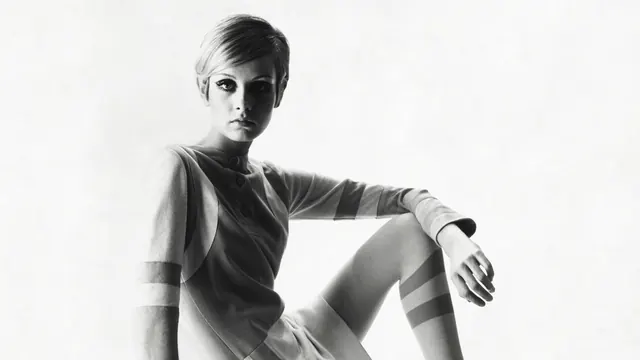
When I speak to Twiggy, we’re sitting near the back of a quiet Italian restaurant in Chelsea. It’s a beautiful late-summer day, and people are enjoying lunch on the sunlit terrace.
Twiggy—who achieved global fame at just 16 years old, becoming arguably the world’s first true supermodel—is in the midst of a busy week: last night, she hosted a screening party at Sloane’s in SoHo for a new documentary about her life, where guests like Fran Drescher, Ellen von Unwerth, Iris Law, and Donna Karan paid her tribute. In a few days, she’ll be in Los Angeles, hosting another screening.
Before this trip, Twiggy, now 77, hadn’t visited New York since before the pandemic. The very first time she touched down here, however, she was 17 and immediately mobbed by fans.
“I landed and they were teenage girls with banners up with my name,” she remembers. “I came in after the Beatles, so I became part of the British Invasion... I was one of the invaders.”
Before becoming the biggest model in the world, Twiggy, born Lesley Hornby, was brought up in suburban London, where she began going to mod clubs at 13. “I was a school girl, so I was only allowed out on a Saturday night.
I had a strict curfew. I had to be home by 10:00,” she says.
“We’d go to a club in another suburb of London. The thing about mods is you wore the same things.
It was a uniform.” Twiggy and her friends would emulate the older girls, wearing the established “gray pleated skirt that came just below your knee, Hush Puppies shoes, and a navy blue nylon raincoat,” as she recalls.
Then a Saturday girl at a hairdresser, she would save up her tips to shop at the storied London boutique Biba. “It was like our church, going to Biba,” Twiggy says. “Every fourth week, we’d run down to Biba during our lunch hour. You could get a dress for two pounds and it was brilliant.”
It’s ironic that Twiggy spent her spare time working in a salon, because it was at the hands of a hairstylist that her life changed. In 1966, Leonard Lewis, also known as Leonard of Mayfair, gave Twiggy her iconic chop.
“I didn’t want my hair cut,” she confesses. “I was sitting in this posh salon in Mayfair and I was too shy to say no.
Thank God, because if I hadn’t had my hair cut, none of this would have happened.”
Photographer Barry Lategan captured the boyish crop, and the picture was hung up in the salon, where it caught the attention of Deirdre McSharry, a fashion journalist at the Daily Express. The publication quickly heralded Twiggy as “The Face of ’66,” and from there, she was off—though those first snapshots remain among her most famous.
Twiggy’s director, Sadie Frost, tells me how the project came together. Frost—who returned to school in 2019 to get her master’s degree in film production—was promoting her directorial debut, a documentary about the designer Mary Quant.
Twiggy had Frost as a guest on her podcast, Tea With Twiggy, and asked her what she was working on next. “At that moment, I realized I didn't have a job,” Frost says.
“I’d been working for three years on Quant and I hadn’t thought about the future because I was so consumed with that. And it just spurted out: ‘Oh, I don’t know.
Let me do a documentary about you.’”
Twiggy was hesitant; she’d been approached a few times over the years and always backed away for different reasons. “It’s a big commitment to agree to have somebody put your life on the big screen,” she says.
But she didn’t immediately turn Frost down, suggesting that they chat more off the air. Prior to speaking on the podcast, the two had run in similar social circles but never properly gotten to know each other.
They went out to lunch the following week.
“We got on really well,” Twiggy says. “I liked the fact that [Frost] was a woman. She’s been a model, an actress, a designer. She’s been in the public eye since she was about 15.” They got each other. “I thought, she’ll understand where I’m coming from and what I’ve lived through.”
“By the end of lunch, she said yes,” Frost says.
The project took three years to complete. It features interviews with people from across the entertainment industry, among them Sienna Miller, Stella McCartney, Brooke Shields, Edward Enninful, and Sir Paul McCartney.
Frost decided whom she wanted to speak to based on the themes she planned to address in the film and who had the most to say about them. “I knew Sienna Miller—being young, blonde, a model, an actress—could really relate to Twiggy,” Frost reflects.
And besides being a personal friend of Twiggy’s, Paul McCartney shared her working-class background.
The film also uses extensive archival footage of teenage Twiggy, which Frost says was one of her favorite things to research. “There’s this authenticity and naivety and innocence,” Frost says.
“You really had these very upper-class, middle-class models who were very put together. And then Twiggy came along and just blew that out of the water.” One clip, which has been making the rounds on social media, sees Twiggy being interviewed by a condescending Woody Allen, who asks her to name her favorite philosophers.
Twiggy is visibly uncomfortable before turning the question back on him. He has no ready answer.
Some viewers may be surprised to discover that Twiggy’s modeling career lasted for only five years; she retired from full-time modeling in 1970, pivoting to acting and other pursuits. I ask Frost how she dealt with balancing what Twiggy is best known for with everything that came afterward.
“You are remembered for the moment you became famous a lot of the time, then you might have a career for 40 years after,” Frost says. “But then she went on to win Golden Globes.
She went on to do albums, she had a TV show.” Frost’s mission as a director was to make people aware of all the other things Twiggy accomplished after getting her first big break.
“There’s a bit of Eliza Doolittle in me,” Twiggy admits when talking about her career. (She should know; Twiggy played that character in a 1981 television adaptation of George Bernard Shaw’s Pygmalion.) “I came from the wrong class. I would never have gone to a modeling agency and they wouldn’t have taken me because I was too small, too thin,” she says. “What happened to me shouldn’t have happened.”
I ask her what she’d tell that teenage version of herself, so utterly unaware of what was coming around the bend. “‘Be brave and go for it,’” she replies. “But I think I did.”
Twiggy is available on DVD and VOD from September 22.