
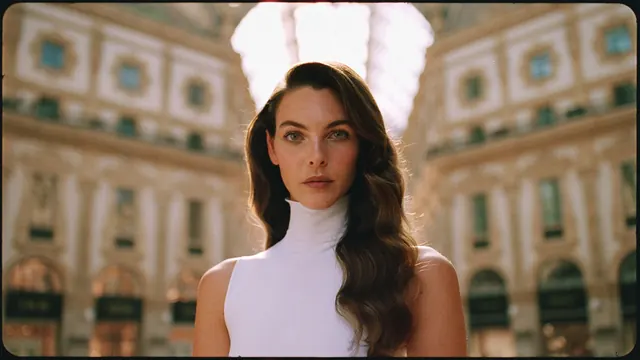
If there’s one thing that has always fueled Italians’ passion, it’s the pursuit of beauty. And that goes far beyond mere aesthetics: Italian beauty is deeply tied to identity, uniqueness, and the art of being, not to mention a healthy dose of drama and self-deprecating humor.
The pursuit of great beauty is a shared life mission from Calabria all the way to the Alps. And perhaps this is precisely the great strength of Italians: the constant ability to see the most beautiful side of everything and ultimately of life itself.
Vogue World: Milano, Vogue’s global event taking place tomorrow, aims to celebrate all things fashion and craftsmanship through the ages, focusing not only on aesthetic details but also the broader values they embody.
Before you tune in at 2 p.m. ET/ 11 a.m. PT, let’s take a walk through history and beauty—so much beauty!—together.
The Obsession with Hair in the Italian Renaissance
Have you always thought that the obsession with blonde hair began in Hollywood? That’s not exactly the case.
During the Renaissance, Venetian noblewomen spent their days on the terraces of their majestic palaces overlooking the Grand Canal, wearing a distinctive hat without a crown (solana) in order to lighten their hair while basking in the sun, after applying strange concoctions made from lye and lemon. The result?
The legendary “Titian blonde” shade, which was named after artist Titian Vecellio.
The aesthetic standards of the era defined a person’s identity and social status: Skin had to be alabaster white (often achieved with poisonous lead white), body shapes were soft and reassuring, and the forehead was very high—so much so that ladies would shave their hairlines just to appear more intellectual.
La Dolce Vita of The 1960s
Skipping a few centuries of Baroque wigs and 19th-century corsets, we arrive at the post-war era and the maggiorata. Sophia Loren, Gina Lollobrigida, and Silvana Mangano took hold in the collective imagination.
Beautiful, sensual, curvaceous, reassuring, and authentic—Mediterranean beauty personified. They wore bold black eyeliner smudged into feline flicks; their lips were either fiery red or nude with defined contours; and their hair boasted voluminous styles held in place by generous amounts of hairspray, often accessorized with headbands.
It was a genuine and warm beauty, evoking sunshine, Sunday pasta with tomato sauce, and innate elegance.
Milano Supermodels
In the 1980s, the center of beauty shifted to Milan. The Italian It girl was a successful woman who managed to juggle family and career, and perhaps even walked the runway for Armani and Versace. In this decade, everything was over the top. Fuchsia blush all the way up to the temples; vivid eyeshadows; thick, wild eyebrows; and permed hair with maximum volume. Being eccentric was almost a civic duty.
In the ’90s, the approach changed. It was the era of the supermodels. Stunning, unattainable models, such as Monica Bellucci, embodied a blend of Mediterranean sensuality and international allure. Makeup leaned toward shades of brown, and lips were outlined with dark pencils. The concept of “less is more” was just beginning to take shape.
Lip Gloss, Tans, and the Rise of Pop Stars
The arrival of the new millennium was marked by the influence of trends from across the Atlantic: the explosion of commercial TV, the MTV boom, and the allure of pop stars had a significant impact on the aesthetic standards of the era. Tans were deep and year-round; lip gloss was all the rage; glitter adorned the body; and eyebrows were super thin—a look that would become the biggest regret for many.
Finally, hair was worn in a crimped style with dramatic highlights. It was an aesthetically chaotic decade, but also one of the most fun and iconic that Y2K nostalgia is still very much alive.
Beauty in the Age of AI: Algorithms, Filters, and the Italian-Girl Aesthetic
And today? Today, Italian beauty is experiencing a dual identity, suspended between a return to greater naturalness and the digital revolution.
On one hand, the Italian-girl aesthetic is all the rage: that effortless look characterized by glowing skin, natural hair (as seen in the Italian Bob), and a touch of mascara. Minimalist yet meticulously crafted down to the smallest detail.
On the other hand, Artificial Intelligence has arrived and, without us even realizing it, has begun to change the rules of the game. AI has created a “universal standard” that risks flattening beauty, erasing the unique features of people’s faces. Furthermore, the creation of perfect virtual models—who never age and are always available—can pose a significant risk to how young women perceive beauty.
Today’s Real Challenge
Historically, Italian beauty has always captivated us, not because of the golden ratio of facial features, but because of its expressiveness, charming imperfection, and characteristic boldness, which allows one’s entire personality to shine through. If the algorithm wants us all to be the same, the new frontier of Italian beauty will be to reclaim the value of the imperfection—a telltale expression, a gray hair, that sense of natural disorder that makes us human and irresistible.
Because, as Vogue World Milano teaches us: not everything can be generated by AI, least of all, the proud, confident, and exuberant Italian beauty.