
“Yes, my friend, Milan is truly beautiful, and believe me when I say that it sometimes takes real determination to resist its temptations and stay focused on work,” wrote the acclaimed Italian novelist Giovanni Verga in a letter to fellow writer Luigi Capuana in 1873. Born in Vizzini, a small town in the province of Catania, Verga was won over by Milan soon after he moved to the city, finding it a rich source of creative inspiration.
When Verga wrote his letter, he was a new arrival in Milan with all the enthusiasm of a recent convert, but his sentiments are also shared by those born and raised in the city. Many locals are almost obsessively determined to preserve their favorite rituals and support their most beloved insider spots, grounded in tradition and the authentic spirit of Milan.
While there will always be exciting new openings, it is often the old favorites—places that have been visited many times over the years and decades—that provide the setting for the most lasting memories.
These places retain their simple charms, remaining true to what first made them popular. To some, they might seem old and outdated, but that is precisely why they speak to the essence of Milan. It is a city that is alluring thanks to its restrained elegance and charm, not for its superficial flash.
Now that we’ve provided some context behind the places in this article, here are the addresses you’ll want to add to your “old Milan” itinerary—whether you are visiting the city for Vogue World 2026, taking place on September 22 at the Galleria Vittorio Emanuele II, or simply there on vacation. The small, everyday traditions allow you to get to know Milan more deeply and experience the city beyond the main tourist sites.
Coffee at Pasticceria Cova
Distracted by the appeal of all that’s shiny and new, we often lose sight of the beauty and charm of simplicity and tradition. Case in point: the favorite Italian ritual of a pause from daily life in the form of a cream-filled brioche paired with a macchiato.
Few places in Milan can provide this experience like Cova. The café has an understated counter with just a few pastries, but you can be certain that they’ll all be delicious.
In 1817, Antonio Cova, a soldier in Napoleon’s army, first decided to open a pastry shop next to Milan’s Teatro alla Scala. It is an elegant spot that has remained practically unchanged ever since, with its mirrors and chandeliers.
Cova has long been a popular after-show gathering spot for artists, writers, musicians, professors, and public figures. And today, it’s an institution, known worldwide since its acquisition by the LVMH group in 2013.
The original café, on Via Montenapoleone, remains a magical place that exudes a quintessentially Italian—and, more specifically, quintessentially Milanese—spirit, where you can feel the warmth and charm of the city and its history.
Breakfast at Marchesi 1824 on Corso Magenta
It’s impossible to stroll down Corso Magenta without noticing the display windows of Marchesi 1824, just as it’s hard to pass up breakfast at the pasticceria —especially on Saturday mornings with a newspaper in hand while enjoying the feeling that time has slowed down. In 1824, Angelo Marchesi opened his pastry shop on Via Santa Maria alla Porta, at the intersection with Corso Magenta, just a short walk from Milan’s Duomo.
In 2014, Prada’s acquisition led to a proliferation of Marchesi cafés throughout the city and around the world. But what makes the original Marchesi 1824 so magical and charming today, 200 years after it first opened its doors, is the preservation of its early 20th-century interiors with coffered ceilings, antique mirrors, and Art Deco light fixtures.
Panini at De Santis
Once again, Corso Magenta is where it all began. In 1964, Renzo and Dina De Santis had the idea to create “artfully prepared panini.” For the first time, Milan residents began talking about grabbing a “quick bite to eat”—still a novelty at the time.
But Milan, a city whose residents are always on the move, embraced the idea of eating a sandwich on the go, and De Santis’s panini worked their way into the hearts of locals. The original De Santis, which has since expanded to several locations throughout the city, still retains its original decor and the same wooden counter from 60 years ago.
The sandwiches are always prepared to order, and the bread, made using their own recipe, finishes baking just minutes before being served. But De Santis is also wonderful at the end of the day, when the sun sets and Milan slowly begins to wind down.
It offers an excellent selection of cocktails to sip while sitting on a small wooden stool outside the restaurant, watching smartly dressed locals on their way home or to dinner, trams passing by, and the city exhaling in that magical pause between the workday and evening.
Panzerotto at Luini
Seeing a film at the Odeon cinema followed by stopping at Luini for a panzerotto, a cousin of the calzone, was long a favorite Milanese ritual. Even though the movie theater is gone (it closed in 2023, after 94 years), locals still can’t resist the panzerotto.
For many, the little treat brings back memories of romantic summer evenings (even if some are put off by the long lines of tourists at Luini’s today). Luini’s story begins in 1949, when Giuseppina Luini moved to Milan from Puglia and took the helm at a bakery at Via Santa Radegonda 16.
Her focus was always on the traditional products of her homeland. First and foremost among these were panzerotti, a typical Apulian dish, made following her grandfather’s treasured recipe.
The tomato and mozzarella panzerotto is Giuseppina’s own creation, and you can’t go wrong ordering it. But over the course of Luini’s history, several variations have been added, all strictly adhering to the same process when it comes to cooking the treat.
“I’m attached to traditions; I even had a hard time accepting the addition of an electric roll-up gate outside the bakery. The shop may change its decor, but the spirit that drives it remains a constant.
We’re proud of the name that appears on the sign,” wrote Giovanni Luini, Giuseppina’s son, in his book Volevo Solo Fare il Panettiere (I Just Wanted to Be a Baker), published in 2021.
Marrons glacé and pralines at Giovanni Galli
Candied chestnuts and violets, dark chocolates, and pralines are the specialties at Giovanni Galli, on Corso di Porta Romana. Opened in 1911, it became the official supplier to the House of Savoy in 1942.
For over a hundred years, the production techniques for sweets at Galli have remained unchanged, perhaps thanks to the fact that the business has always been family-run, and the recipes—as well as the loving dedication around their preparations—have been faithfully passed down through the generations. Everything is made by hand and without the use of any preservatives.
In the fall, some of the chestnuts are turned into marrons glacé to be sold directly at the counter, while others are left in the cooking syrup and preserved so they can be sold in the following spring and summer.
Rotisserie chicken at Giannasi
There’s one thing that sets true connoisseurs of Milan apart: They will have dined on Giannasi’s rotisserie chicken at least once in their lives. The chickens are sold at a little kiosk on Piazza Bruno Buozzi (in the Porta Romana area) that has become a Milan landmark.
For many, there’s no better spring evening than one spent with friends sitting on one of the benches in that little square. In the 1950s, the Giannasi siblings—Graziella, Dorando, and Luciano—who hailed from a small village in the Tuscan-Emilian Apennines, moved to Milan in search of work.
Later, in 1966, they spotted the kiosk, which was abandoned at the time, and decided to renovate it. Everything has remained the same since they opened their doors in 1967.
You get in line, take a number, and wait your turn while watching the bustle of Milan all around you. Even though you may be tempted by the many options on the menu, we recommend ordering the classic meal: “Un pollo allo spiedo e una vaschetta di patate al forno, grazie” (or “a spit-roasted chicken and a tray of baked potatoes, please”).
If you’re feeling adventurous, the mint potato croquettes are a delicious surprise. Honestly, whatever you decide to order, it’s all wonderful.
Gourmet favorites to go at Peck
In Milan, and elsewhere in Italy, there’s an abundance of gourmet stores selling prepared foods that allow everyone, including visitors without kitchens, the ability to serve an exquisite, impromptu meal. These institutions haven’t always been there, and it was Francesco Peck (the man who founded this popular deli) who promoted his establishment’s prepared foods by inviting friends and prominent society figures to dine in his home.
The shop’s remarkable story began in 1883, when Peck, who was originally from Prague, decided to open a store specializing in cured and smoked meats at Via Orefici 2. His goal was to make it the city’s most prestigious delicatessen, and he succeeded: Peck would later become the official supplier to the House of Savoy.
In 1912, it moved to its current location at Via Spadari 9. A visit offers a true immersion into one of the culinary highlights of Milan.
An aperitivo at Bar Jamaica
A good bar is not just about enjoying a well-prepared drink, but doing so with the right people in an intimate setting where you feel exactly like yourself. Bar Jamaica, in the heart of the Brera neighborhood, is exactly one of those places.
It is simple and unpretentious, yet full of life. Jamaica first opened in 1911, and it quickly became a meeting place for the intellectuals of the time who frequented the adjacent Accademia di Belle Arti di Brera.
Writers and artists would gather to exchange ideas, argue, gossip, or simply to enjoy a good cup of coffee. If these walls could talk, they’d have many, many memories, legends, and anecdotes to share.
Today it remains ready to warmly welcome another generation of Milanese locals and visitors, offering cocktails, canapés, and a magical space in which to dream.
A Campari seltzer at Camparino, in the Galleria Vittorio Emanuele II
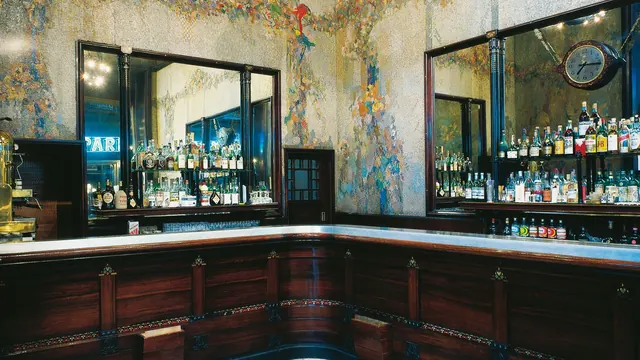
In the heart of the Galleria Vittorio Emanuele II, Camparino is one of those places where Milan’s history continues to unfold naturally. Opened by Davide Campari in 1915, it has become synonymous with the ritual of the aperitif in Milan, frequented by intellectuals, artists, and other prominent figures.
The Art Nouveau interiors, featuring mosaics and furnishings designed by leading artists and artisans of the era, evoke an elegant and cosmopolitan Milan, while at the bar, the Campari seltzer remains the house specialty. Overlooking the Duomo, Camparino retains the feeling of being a welcoming and elegant lounge where you can stop for an aperitif, watch the activity in the Galleria, and feel, for a few minutes, like you’re part of its history.