
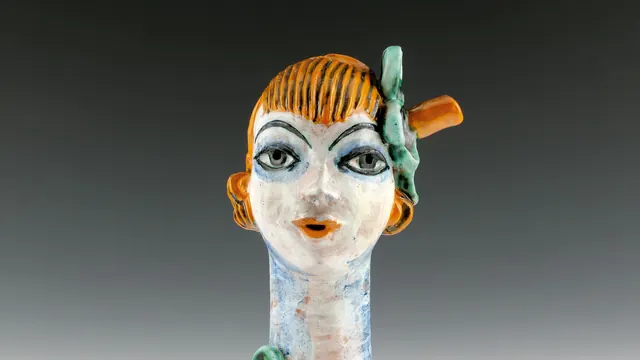
This fall, New York museums are mounting an intriguing mix of shows that speak to notions of girlhood, nostalgia, and feminine self-expression across time, cultures, and creative disciplines. As diverse as the subjects of these exhibitions are—spanning schoolgirls and screen sirens—poignant parallels arise, whether it’s the assumed connection between women and domesticity, or the perpetual dismissal of art made by women as craft.
Discover here six must-see shows grounded in scholarship on female practices and pursuits.
“Modernity and Opulence: Women of the Wiener Werkstätte”
At the Jewish Museum through November 15, 2026
Design enthusiasts will be familiar with Josef Hoffmann and Koloman Moser, the architect and artist who established the Wiener Werkstätte in Austria at the turn of the 20th century. Lesser known, however, is the fact that through their classes at the Kunstgewerbeschule (School of Applied Arts), they provided a vital creative loophole for women artists and makers who could not attend fine arts academies until the 1920s (training in the decorative arts was considered close enough to their domestic responsibilities).
Organized in collaboration with the Museum of Applied Arts, Vienna (MAK), the Jewish Museum’s latest exhibition illuminates how these women became central to the Wiener Werkstätte’s commercial success in Austria and beyond.
“Modernity and Opulence: Women of the Wiener Werkstätte” presents more than 200 objects, ranging from fashion illustrations and block-printed textiles to jewelry and ceramics, by Jewish women artists. Female patrons are also highlighted: for example, Adele Bloch-Bauer, the subject of Gustav Klimt’s famed “woman in gold” portrait (a drawing of Bloch-Bauer by Klimt is featured in the show).
Wiener Werkstätte objects designed by women were included in the legendary 1925 Paris International Exhibition of Modern Decorative and Industrial Arts, as well as in Hollywood films, but their creative legacy and role in shaping modernism should not be overlooked today.
“Doll Dressing”
At the Museum at FIT through January 3, 2027
Thanks to the Museum at FIT, Barbie is back—but she’s far from the only plastic muse on view. “Doll Dressing” chronicles how dolls have been transmitters of style for centuries (even as early as the 14th century, when they were circulated throughout Europe as miniature fashion models).
The more than 170 objects include full-size garments, too, by the likes of Marc Jacobs, Moschino, Loewe, and more designers known for their play with proportion and trompe-l’oeil. Thematic sections draw on childhood play and identity formation, as well as the impact of subversive dolls, such as Mattel’s Monster High line.
Don’t miss the “Modes in Miniature” display, which brings together runway looks with miniatures versions by Emily Adams Bode Aujla, Anna Sui, and Jason Wu, among others.
“Goddesses in the Machine: Fashion in American Silent Film”
At the Bard Graduate Center through January 3, 2027
Tracing the origins of the film-costume-design industry from the late 19th century to the introduction of “talkies” in the late 1920s, “Goddesses in the Machine” is the first major exhibition to explore fashion in American silent film. Photographs, posters, and sketches are presented alongside rare surviving garments and movie clips to illustrate how costuming became an indispensable tool for storytelling and character development, often guiding actresses’ offscreen styling as well.
Chronologically organized over four floors, the exhibition begins with actors wearing their own clothes in films, followed by the rise of New York costume designers (Henri Bendel and Lucile, Lady Duff-Gordon) and the shift towards Hollywood studios (Clare West and Travis Banton). Undersung designers are also given their moment in the spotlight, making this exhibition crucial for preserving early cinematic history.
“Hopi Kachina Dolls: Blessings for a Balanced World”
At the Brooklyn Museum from October 2, 2026–April 18, 2027
While the Museum at FIT’s doll exhibition explores dolls as purveyors of fashion primarily in the 20th and 21st centuries, the Brooklyn Museum offers a deeper look at the longstanding significance of dolls for girls and women in Hopi (an Indigenous tripe in northeastern Arizona) traditions. Intricately crafted from cottonwood and painted, kachina dolls represent Katsinam, spirits who bring moisture and keep the world in balance.
Kachina dolls additionally mark milestones in a Hopi woman’s life, as they are gifted, for example, during baby-naming ceremonies and marriages, along with other objects, such as pottery and baskets.
Drawing largely on its expansive Indigenous art collection, the Brooklyn Museum presents more than 120 artworks, including 53 kachina dolls, from the 19th century to the present. A newly commissioned video underscores their importance through interviews with Hopi artists and community members.
“Locating Girlhood: Place and Identity in Early American “Schoolgirl” Art”
At the American Folk Art Museum from October 9, 2026–February 28, 2027
Presented during America’s 250th anniversary year, “Locating Girlhood” gives new weight to the early American traditions of needlework and ornamental arts. During the 18th and 19th centuries, samplers, watercolors, and craft-based art forms were part of girls’ education. Historically labeled as “schoolgirl art,” however, these objects have largely been undervalued in the canon.
With nearly 100 works (many loaned from the nation’s leading institutions), this exhibition reconsiders its chosen subject matter from a conceptual standpoint—in particular, why representations of place were so prevalent in works made by girls and young women. Anticipating the popularity of American landscape art, these works uniquely reflected shifting social values, as well as girls’ complex inner worlds.
“The Mantilla: Fashion Unveiled”
At the Hispanic Society Museum & Library from November 20, 2026–March 28, 2027
Nearly one year after it presented “Spanish Style: Fashion Illuminated, 1550–1700”, the Hispanic Society Museum & Library continues its multi-year fashion initiative by focusing on one of Spain’s most iconic accessories: the mantilla. As the first major museum exhibition devoted to the object, the show examines the lace veil as a symbol of modesty, femininity, and national identity.
Paintings, photographs, textiles, books, and extant garments span the 18th century through the present (space is also dedicated to contemporary fashion designers who have reinterpreted the mantilla in a multitude of ways). “This exhibition reveals how a single garment can illuminate the political and artistic histories of Spain while continuing to inspire conversations today,” curator Carlos Usabiaga has said.