
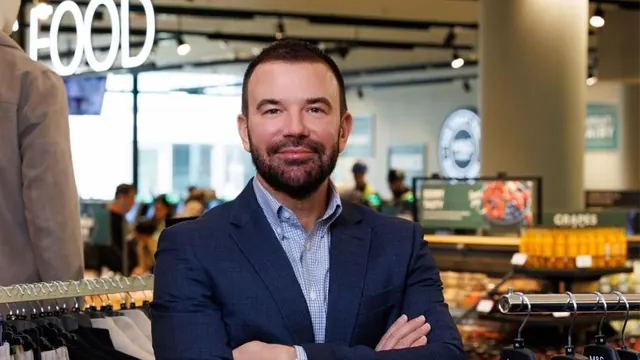
Ask a Brit their thoughts on retailer Marks & Spencer, proudly nicknamed Marks & Sparks or M&S, and many of them will express some level of fondness. They may like the Percy Pig sweets, regularly grab a sandwich meal deal, or test out the ever-growing list of viral products, like the Reggiano Lambrusco sparkling red wine.
But as of late, it’s not just M&S food (and now-viral director of product development, Kathryn Turner) that’s prompting buzz. M&S fashion has upped its game in recent years, under chief executive Stuart Machin, who was appointed in 2022, and is in the middle of a major turnaround spanning product, supply chain, marketing and more.
To underscore its fashion ambitions, M&S will make its runway debut at London Fashion Week this Friday. The see-now, buy-now show, focused on its Fall/Winter 2026 collection, will feature reworkings of archival hits, while the diverse casting will reflect M&S campaigns, consumers and brand ambassadors. Crucially, half of the collection is under £50.
“Every year for the last four years, we’ve improved our style perception,” says Machin, sitting in M&S HQ near London’s Edgware Road. A plate of M&S pastries sits on the table, which he admits are a little dry (feedback for the team later).
In the corner hangs his M&S trench coat, a product he’s proud of from last season. And on two TV screens by the window is a clear outline of his fashion strategy across two slides.
The crux is, while perception of M&S fashion has certainly improved, the business has a long way to go to reach the growth and profitability of M&S food.
Shifting perception
M&S was always popular for lingerie and basics. In fact, in the UK, around half of women on any given day are wearing an M&S bra, the company says.
But when I put a callout on Instagram asking if anyone was buying more M&S fashion lately, I received around 50 messages in 12 hours. “Loving it!
I never bought from there [until] recently,” wrote photographer Bethan Smith. “It’s gone from being reliable to being relevant,” wrote tech executive Lauren Dyer.
The consensus is that M&S fashion is now cooler and more exciting, which is appealing to a younger, more fashion-forward shopper than before.
“If you look at what the team really did, it was a product,” Machin says. “We deliver better quality, better style and better value today.” In practice, this means more trend-led, directional design, from funnel neck jackets to satin bombers, colorful ballet flats and wide-leg jeans.
Machin built a fresh team to steer the product turnaround. He promoted Maddy Evans — former fashion director of Topshop in its 2010s heyday — to womenswear director in 2022.
She spearheaded the product transformation, and in February 2025, was promoted to director of woman, incorporating all women’s sub-categories like lingerie and accessories. That same year, the company appointed former Boohoo chief executive John Lyttle as managing director of fashion, beauty and home, to help steer a much-needed turnaround at the back end of the business.
M&S, and particularly the fashion business, has weathered a fair few challenging years. The retailer fell out of the FTSE 100 in 2019 amid sliding shares and faced profit losses during the pandemic, before a steady recovery from fiscal 2022 (it returned to the FTSE 100 in 2023).
Then, last year, the retailer was hit by a cyber attack that disrupted operations and online orders, costing the business roughly £300 million in lost profits. “We refer to it as ‘the incident’,” Machin says.
The company is still feeling the effects. Revenue grew 25% to £17.3 billion in fiscal 2026, but pre-tax operating profits fell 23.8% to £671.4 million.
Within that, fashion sales declined 7.7% to £3.9 billion, with adjusted operating profit down 55.4% to £213.4 million. Sales grew 0.2% in the second half of the year, reflecting the recovery of online trading after “the incident”.
While the company has invested significantly in technology to avoid further breaches, the effects of it continue to weigh on the fashion business.
“In truth, fashion is slower than the food turnaround, because in food, we started our transformation a long time before,” Machin says. “If you look at our food supply chain, our new food stores, you can see — a lot of that is around better products, better supply chain, better partnerships with our suppliers, a better online [experience], and better value.”
Machin still sees much opportunity in fashion. “M&S has a total customer base of 32 million. But the fashion business has only 21 million customers,” he says. That leaves a lot of revenue on the table. But how can he modernize M&S fashion and boost sales volume with young shoppers, without alienating the existing millennial, Gen X, baby boomer and silent generation consumer?
A relatable runway
To quote M&S adverts, Friday’s fashion show won’t be just any fashion show; it’ll be an M&S fashion show. The plan is to remove some of the friction Machin has experienced when attending shows himself over the years.
“No criticism, because I’ve enjoyed the few shows I’ve been to. But firstly, you’re rushed in; you don’t get a drink.
Secondly, you’ve been given a chair, if you’re lucky, and even if it’s reserved, someone’s sitting in it. Then you find a chair, and you’re half-sitting on the chair — one cheek on, one cheek off — sharing the chair with somebody else, and all these little things.”
So, he briefed his team: snacks and drinks on arrival, clearly marked toilets (honestly, never a given), and ample space for everyone to sit comfortably. “I want [the London show] to be comfortable.
I want it cool, but I want it very grounded,” Machin says. “I want it to feel like M&S, because where we can go wrong — and it’s happened a bit this summer — is I don’t want us to be too cool for school.”
Machin is referring to M&S’s Ibiza runway show, which unveiled its SS26 Love That collection with a high-profile, live-streamed show at a resort overlooking the island’s Cala Carbó. The show was presented by Chicken Shop Date’s Amelia Dimoldenberg, featuring celebrity guests like Dannii Minogue and AJ Odudu.
More than a million people watched the show on YouTube within 24 hours, which Machin didn’t anticipate, soon making him realize the power of a runway show when done right.
Still, there were lessons to be learned. “It doesn’t mean this is wrong, but we had a lot of young, tall, skinny models,” Machin says. “There’s no doubt we’re attracting more under-35s, and our small-size ratios are doubling every year. But if I look at my friends, I’ve got friends who average a size 10 to 20. And that’s M&S. I’ve said this [London] show has to be more real.”
Machin recalls M&S’s latest annual general meeting, when an employee asked, “Do you think you went a bit skimpy?” It reminded him of feedback he got from his mum earlier in the year: she complained that the M&S dresses on offer were all sleeveless, and that tops weren’t long enough to cover her tummy. “I just want the fashion to be accessible,” he says, “It’s got to be different, but it’s got to be quality — plus style, plus value for everyone.”
M&S also held a runway show on the pit lane at the Formula 1 British Grand Prix at Silverstone in July. Machin took some convincing on the concept, which he says was his friend, British model Jodie Kidd’s, idea.
“She said, ‘Stuart, 65 million people watch it, and no one has done this yet,’” he says. “Louis Vuitton and other brands are all there, but no one has done a catwalk — so we did it.” M&S signed a three-year partnership with the F1 team Williams, providing the drivers’ travel kit, and activating at Silverstone.
Machin was thrilled with the outcome once he saw just how diverse the audience demographics are.
M&S is also investing in social media and talent like never before. The brand now works with popular British fashion creators like Melissa’s Wardrobe (known for her styling videos and work with Stormzy), Instagram talent Hollie Mercedes (260,000 followers) and Lucy Nicholls (44,500 followers), plus menswear creators like Nathan Griffiths (87,000 followers) and Tim Dessaint (724,000 followers).
To boost appeal with a younger audience, and stoke nostalgia for existing customers, the brand revived its old St Michael label for a collaboration with London-based streetwear label Aries in August. The Aries collaboration delivered 55% sell-through on launch day alone, according to M&S, with strong performance throughout the entire first week.
The retailer is also benefiting from employee-generated content. When Machin joined four years ago, he relaxed the then-strict rules on staff posting about M&S on their social media.
Then, when two graduates advised director of product development Turner to post on TikTok about the latest M&S food innovations last year, she became a viral hit. Many of Turner’s videos have over a million views, garnering a collective 2.2 million likes on TikTok alone.
It’s having a halo effect on the fashion side, too. Machin recalls a recent visit from his 17-year-old nephew and his girlfriend, who told him M&S is “cool” and that she’d just bought a cami top from the brand.
“I nearly fell off my chair,” he laughs. “She asked me if I know Kathryn.”
A long way to go on the backend
While M&S brand perception is seemingly glowing, the business is still struggling to prop up the growth. M&S fashion’s online supply chain is out of date, and the technology costs are high, Machin says, so online margins are much lower than their competitors’ (M&S’s main fashion competitor is British retailer Next).
Since Boohoo’s Lyttle came on board, the company has started a full end-to-end reset of its fashion supply chain, tapping a new distribution and former Asos partner, Lichfield, to improve fulfillment. M&S has also opened a new returns center to improve processing, and is striving to improve its suppliers.
“[Today] if you order something from M&S, you might get three parcels, not one,” Machin flags. “We’re currently more multi-channel — it’s stores here, online there.
And if we look online, we’re running at 33% participation; we want 50%.”
As the M&S consumer base grows, and certain design-led products become hot property, availability is another challenge. This summer, certain cult-like products sold out quickly, while replenishment lagged. “We’ve just scratched the surface on that,” Machin says. “Our merchandise planning platforms are all changing. So all of that, every tech system in fashion, is changing over the next five years — it’s pretty big.”
M&S fashion also had its sights on business abroad. The brand is already stocked at Nordstrom and on Zalando-owned European e-commerce platform Zeos, but the international business is softer than Machin would like.
“We’re just getting our act together because this is a big opportunity,” he says. “In the next five years, international fashion should be a volume growth opportunity for [us].
But we’ve only really just started. We used to just let the franchise partners look at the core product and buy what they needed — they never bought new things.
So we’ve said, ‘We want you to see all our range, not just the jeans and the everyday black leggings, and we need to back you and help you take risks and share some of the pain and the gain.’”
When Machin joined M&S in 2018 to run the food business, he was quite surprised that the head office didn’t listen to stores, and felt there was a distinct lack of consumer insight. “I like leadership to take real accountability,” he says.
“Before, we kept changing our strategy every year, saying things and then changing what we said… Now, we tell it as it is. It’s about us acknowledging the issues.
It’s about when it’s a bit tough, we all hold hands and go, ‘Are we doing the right thing?’”
In his spirit of candor, he points to M&S’s UK fashion market share: it fell 4% last year for Spring/Summer, and 6% in 2024. “We didn’t get that right.
We sold out of all the good things, and we had too much of the things people didn’t want,” Machin says. “We also missed out on what I call classics.
Sixty percent of our business is still core — it’s the denim, it’s the leggings, it’s the £10 bra and the men’s chino. We focused our time on fashion; now we need to balance both.”