
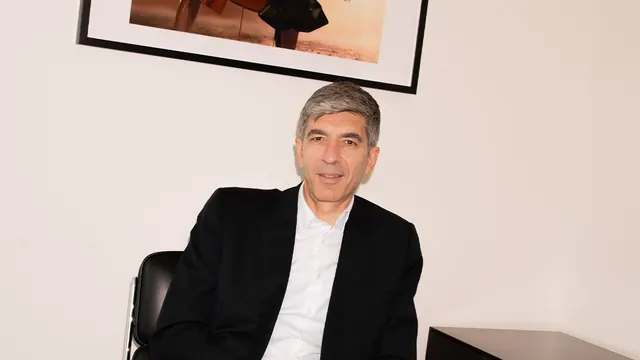
Fashion CEOs generally avoid interviews in their first year on the job. Some want to be able to present results; others need more time to put together a strategy.
But Gianfranco D’Attis, who only joined as CEO of McQueen in June, had a plan that he was ready to put into practice from day one. “I came to this company on June 3, and the first thing we announced to the team was that we would bring the show back to London,” he says.
Lee Alexander McQueen founded his eponymous house in London in 1992 (and showed for the first time during London Fashion Week a year later) but began presenting collections in Paris in 2001, following investment from what was then the Gucci Group and is now Kering. Since then, the brand has only returned to London a handful of times, most recently under Sarah Burton for SS22.
Sunday’s show will be current creative director Seán McGirr’s first in London. (It was McGirr who dropped the ‘Alexander’ from the brand’s logo when he took over in 2024.)
Paris Fashion Week is traditionally seen as offering access to a larger press and buying audience, and therefore a better positioning for luxury brands. It’s why most designers who move their shows to Paris do so, and a sore point for the British fashion industry, which tends to feel that London incubates talent only to lose it and its business to the bright lights of Paris or Milan.
It makes sense that the return of McQueen to London Fashion Week is a moment of celebration for the industry that forged it.
“I was surprised when I found out that McQueen was showing in Paris,” reveals D’Attis, who was previously CEO of Prada. “To me, bringing the shows back to London was a very natural and organic decision. We need to create the right context for our collections and connect the house back to the city that shaped it. London has an energy and an uncompromisingly cool attitude that reflects that of our clients.”
The decision to show in London isn’t a one-off either: “We are very much committed to showing in London from here on,” the CEO adds. “I hope that McQueen will enrich London Fashion Week, attracting more clients and press.
I am very excited about contributing in that way. And at the same time, we get to tell our story in our hometown.” While the shows have mostly taken place in Paris, the brand’s headquarters have remained in London since McQueen’s death in 2010.
It is just the first in a series of what D’Attis calls “quick wins”: small strategy shifts he implemented at the start of his tenure to set an agenda for the company and create momentum around it. “McQueen needed a reset — that was clear to me from before I started this job,” he explains.
“In the past, we made some errors as we tried to diversify our business. We were too exposed in categories that diluted the brand message, like sneakers.
So now we are trying to go back to basics. We want to get McQueen back to the more elevated level our clients expect from us.”
The last few years have been challenging for fashion, and especially for McQueen parent company Kering, which has been undergoing its own wider reset (titled ReconKering) since Luca de Meo took the reins as CEO in September 2025. “I think over time, the fashion world lost its ability to innovate,” says D’Attis, who was hired by and reports directly to de Meo.
“It has been copying itself quite a bit, and has lost its sense of proportion in terms of price. Fashion needs to be more realistic.”
While Kering doesn’t break out sales of its individual houses except for Gucci, de Meo addressed the need for a refresh at McQueen during the group’s H1 earnings call at the end of July: “McQueen is executing its transformation plan focused on simplification and operational discipline. This includes the rationalization of the store network with 20 closures in H1 2026, a right-sizing of the organization, and a greater leverage of group platforms and shared capabilities.
The recent appointment of Gianfranco D’Attis as CEO, in my opinion, marks an important step in the next phase of the house development,” he noted.
The company also underwent a restructure earlier this year that involved job cuts. “We have a wonderful team in London that is very diverse and very driven. And they have gone through a lot in the past few years because of the challenging macroeconomic situation and the volatile market. Part of my job is to support them in repositioning the brand, which is very important for its future,” offers D’Attis.
Relocating the show made the intention of a reset clear. What will drive the message home over the next few years for D’Attis, who spent most of this summer entrenched in the brand archives, is focusing on tailoring and occasionwear, which he feels are the cornerstones of the brand.
“Lee was trained in Savile Row, and precision tailoring was a real obsession of his. He was focused on the technicality of a garment, the way it’s cut.
And so it has to be an obsession for us too. It’s a very important point of difference as we have real credibility in this field.”
That credibility will be further underscored by the house’s involvement in The 90s: Art and Fashion exhibition set to open on October 8 at Tate Britain. The works of photographers such as Corinne Day and Juergen Teller, artists like Damien Hirst, Tracey Emin and Sarah Lucas, and fashion designers including John Galliano and Alexander McQueen have been curated by Edward Enninful OBE to offer an updated look at what was a defining decade for British culture.
“McQueen emerged from the same spirit of experimentation and creative disruption that defined the 90s in Britain. We are supporting the exhibition as a means of celebrating our legacy as well as the incredible artists who fueled that decade. Through this partnership, we want to reinforce our commitment to British art and craft,” says D’Attis.
A relocation, a new product strategy and a well-timed sponsorship; it feels like a lot for anyone to have put together in just three months. But for D’Attis, it is just the beginning: “Before you start a job like this, you have some ideas in mind that you think make sense for the brand.
Then you implement some quick wins that are obvious, while working on the wider brand strategy and narrative that will steer the next three years. We are actually at the point of finalizing that strategy because we will be presenting to the group in the coming weeks,” he explains.
Where does he want the company to be in three years’ time? “I want to have grown McQueen’s ready-to-wear and our shoe category to be well proportioned within this business. I want us to be a leader in tailoring, and uncompromising when it comes to the quality of our products.”