
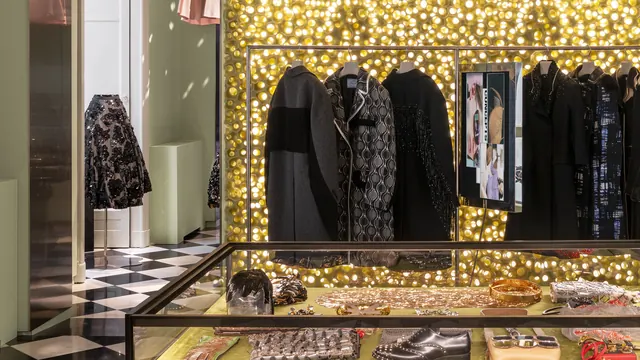
On Tuesday, Prada will preview its newest — and oldest — store.
This typically paradoxical Prada position is thanks to that store’s location: Milan’s Galleria Vittorio Emanuele II. It was here that the company, founded in 1913 and originally called Fratelli Prada, opened its first-ever point of sale.
More than a century later, Prada is unveiling an expansion of that original site — most recently used exclusively as a womenswear boutique — into an eight-floor complex encompassing womenswear and menswear, food, art, private hospitality and, for the first time on a permanent basis, an exhibition dedicated to Prada itself.
From its first Milanese store opened by brothers Mario and Martino Prada, Prada has grown into a global fashion business with 423 directly operated boutiques and reported group revenues of €5.7 billion last year. Since the late 1970s, Mario’s granddaughter, Miuccia Prada, and her husband, Patrizio Bertelli, have driven that growth. Now, Prada is turning its eye for expansion towards its origin story.
The new development is christened Prada Galleria after the arcade it sits within: a Milan landmark that, on September 22, will host the 2026 installment of Vogue World. The Galleria, completed in 1877, was built to connect two established poles of Milanese life — devotion, represented by the Duomo, and culture, by La Scala — with an indoor thoroughfare dedicated to a newer preoccupation: shopping.
The enlarged and redefined Prada space links several pre-existing elements. The historic womenswear site will be merged with the existing menswear boutique via an underground tunnel the company is tantalizingly calling the Passaggio Segreto, or Secret Passage.
Osservatorio Fondazione Prada, inaugurated in December 2016 and dedicated to artistic curation, occupies the uppermost levels. Marchesi 1824, the historic Milanese pasticceria Prada Group acquired in 2014, has operated its Galleria outpost here since September 2016 and will be subsumed into the larger Prada complex.
The architectural strategy of expansion through connection reflects the project’s brand-building strategy. The piano nobile, first-floor space of the original store site will now house a new Pradasphere display, the first permanent exhibition devoted to the house. Tracing the company’s history from the founding of Fratelli Prada, it is designed to connect Prada’s lesser-known origin story with its more celebrated recent history.
Underground, meanwhile, the Passaggio Segreto will, the company says, display lesser-known episodes and objects from the archive: early experiments and obscure “firsts” intended to reveal continuities within Prada that were previously either unknown or overlooked. Above, the invitation-only Appartamento has been conceived under Miuccia Prada’s direction as a hypothetical domestic space: a glimpse into her interior aesthetic.
Before today’s preview, Vogue Business connected with Prada Group’s CMO and head of corporate social responsibility Lorenzo Bertelli (not to mention Mario Prada’s great-grandson) to ask why the company’s strategy for the future demands a new approach to its past.
Vogue: What does this particular site mean to you and your family?
This is where everything started for Prada, so it has a sentimental legacy for the family. Our other stores have been an execution of my mother and father’s ideas, creativity, and vision. This one is different. It was something really personal for them, and both of my parents have been emotionally involved in the project. Because, as you will see, it isn’t only about the store formula. It is about telling our story.
Vogue: And what is that story?
When a lot of people think about the story of Prada, they begin with my parents: the ’70s, ’80s, and ’90s, and what they created then. People forget that Prada’s origins really begin with Mario, my mother’s grandfather, and his brother Martino, when they opened this store.
So this is an opportunity to share that family story. That is probably the biggest difference between what you are used to seeing in Prada stores and what you are going to encounter in this one.
Vogue: The Prada your parents shaped has always been about challenging tradition. So has it been challenging to approach the task of explaining your own tradition and history?
What you will see, especially in the Pradasphere, is that what my parents created did not come out of the blue. There was continuity with what my mother’s grandfather started and with the origins of the brand. That is something many people know less about, and it became our focus.
One of the biggest challenges was deciding what to talk about and what to show. But having so many things in the archive and so many stories to tell is a good problem to have. In fact, the museum space will continue to evolve, because we have discovered so many things we want to share.
Vogue: How did you approach that storytelling?
The biggest question was choosing the narrative perspective, because there are so many ways to see the story: through product; through culture; through the wider history of Milan and the fashion sector; through architecture; or simply through family history. We will only really understand how well the direction we have taken works once we start receiving feedback from visitors, because when you talk about yourself it is hard to zoom out and have an objective view.
This is also something very new for us: we have always been quite esoteric about this knowledge of our family. We haven’t really shared it. We have always been a little shy about it. So we will see.
Vogue: The store contains what Prada calls a Passaggio Segreto, connecting the women’s and men’s stores. The term itself suggests that you are digging into Prada’s less familiar stories. There is something tantalizing for visitors in the idea that they might discover things they never knew existed.
Exactly. The Passaggio Segreto connects the spaces, but it also becomes a place for hidden treasures and unearthed pieces from the archive that people may never have been aware of. It is a place for the unexpected. Of course, there is also the store itself, which is beautiful, and the spaces dedicated to our clients. But in a way we take that for granted.
I think some of the most appealing parts of the project will be the areas not dedicated to commercial sales, but to telling the story of Prada. And then, above that, you have the Osservatorio, part of Fondazione Prada, which is also very close to my mother’s heart.
There is the Appartamento too, which she has approached in a way that reflects how she might imagine living herself: something created from a very personal perspective. It offers a hint of something we have not really disclosed before.
She put a lot of effort into it, and I think it will also become part of her legacy for the future.
Vogue: When you said this is only the beginning, does that suggest Prada is going to focus more widely on telling its origin story and the period of its history before your mother began working in 1978?
I was only a kid, but I remember that when the first Prada store in New York opened [in 1996], the original concept had something in common with the Galleria and spoke about Prada’s heritage. But at that time, Prada was really known for modernism and minimalism. So telling that older story was not particularly successful because people didn’t understand it in the context of seeing Prada as something new.
If you look at the maturity of the brand today, though, Prada is established. Even if it remains very closely associated with minimalism, nylon, and those big moments of the ’80s and ’90s, the brand is now at a different moment in its life.
I think the customer is at a different point too. There is now a willingness to explore Prada’s heritage because the brand is no longer perceived as a novelty.
Every moment in the evolution of a brand requires a different way of communicating.
In fact, this has already begun. In a few of our stores, we have apartments containing furniture and art personally curated by my parents. There are only a handful of them, and they are reserved for top clients, but this is becoming a broader way of communicating.
Vogue: How does this new emphasis on Prada’s past speak to its approach to the future?
It is very common today that when you don’t have something to say in the present, you go back and talk about old ideas. And more broadly, I also think we are living through a moment when people are worried about the future — about geopolitics, the environment, AI. There are a lot of things to be scared of. So it can be uncomfortable to think about the future.
So one of the challenges with this project was that we didn’t want to be seen as a brand looking at the past because it no longer knows how to express the future. Especially within the exhibition, we are showing you our past while also showing that we believe strongly in the future and intend to keep moving forward.
Vogue: Every heritage brand was once an innovation brand. Yet many eventually suffer a kind of mid-life crisis.
That's often when brands no longer know how to move forward. After the innovation that establishes the brand DNA, they can end up simply re-elaborating the past. I think this is a problem every brand faces. The only solution is to have an understanding of contemporary society while still pushing forward. Even then, there are no guarantees of success. But I think that’s really the soul of Prada: to continue pushing forward with positivity.