
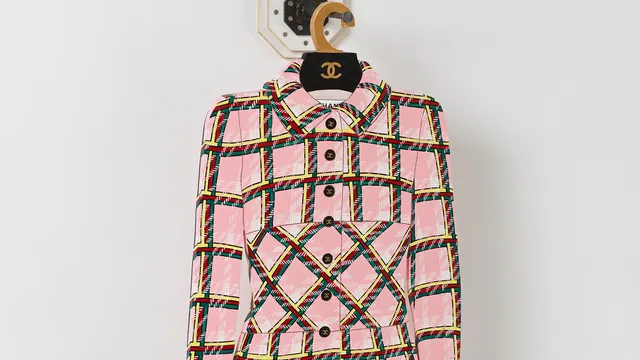
What do Elizabeth Taylor, Olivia Rodrigo, Marge Simpson, and Sofia Coppola all have in common? Of course, they’re all cultural icons—and furthermore, they’ve all been spotted wearing one of Chanel’s iconic tweed skirt suits. As of yesterday, they have another connecting thread: they’re some of the many muses who helped inspire artist Tom Sachs’s heady, humorous new project—an ersatz Chanel store nestled along Centre Street in New York’s Soho neighborhood.
Sachs worked with fashion historian Colby Mugrabi to curate the show, titled 31 Rue Cambon. Together, they built a simulacrum of the iconic Parisian retail location out of humble materials from the outside in.
Inside, the wares hanging in the exhibition create a Chanel store complete with dresses that are all made of plywood that has been painted and manipulated to evoke tweed, embroidery, and other highfalutin textiles and ornamentation. Accessories like the iconic flap shoulder bag are there, too—plus shoes, jewelry crafted from Legos, and other commonplace ephemera.
It is a cheeky celebration and subversion of consumerism, both an homage and a send-up of the ridiculous world of luxury goods.
“I consider everything in here to be a sculpture,” Sachs said, standing outside the “shop” during a preview yesterday. “The clothes—you can't wear them. They're sculptures in the spirit of Claes Oldenburg's The Store from 1961. You know, a hamburger you can't eat, a TV you can't watch, and a dress that you can't wear. But there are these beautiful sculptures.”
“I'm thinking about it in the context of contemporary luxury,” Mugrabi added. “Window dressing is such an important part of the luxury experience today. The exterior of the stores is sometimes as important as when you go inside.” (Fun fact, Sachs once worked on store windows at Barney’s New York during Simon Doonan’s wildly creative run there).
Inside, visitors are greeted by a disorienting octagonal antechamber of mirrors under a chandelier made from bike reflectors, and behind that is a sleek sales floor where the flattened dresses cheerily hang off racks.
Sachs sees the project less as one dedicated to fashion, and more as one about when the “desire for an object [is] sublimated into the experience of making.”
“That's my greatest privilege and accomplishment from my own development as a human being,” Sachs said. “Being able to get away from the lust-envy cycle and into the pure experience of making, which is a lot like what athletes experience in the ecstasy of the game.”
“They say the best things in life are free, but the second best things are very expensive. So this maybe is about that fissure between the second most expensive and the first best.”
It started over longing for a Chanel piece of his own, an obsession tied to an image of Elizabeth Taylor. In trying to recreate her dress, Sachs found that he had to apply his own sort of craftsmanship to come up with a viable recreation.
That sometimes meant scraping through fresh paint, or adding layers of paint extruded through a syringe to create pliable, stringlike material that can be combined to create the textured, multicolored appearance of tweed. Other times they are delicately “painted” to create other details, like the lions commonly found on Chanel buttons (Coco Chanel was a Leo and famously into the occult).
Eagle-eyed Chanel-ophiles may be able to see the cartoon-like recreations and identify their place in pop culture. Sachs and Mugrabi chose to portray dresses worn by iconic women like Princess Diana, Sofia Coppola, Linda Evangelista, Margot Robbie as Barbie, the art dealer Mary Boone, Liza Minnelli, and many others.
Mugrabi, a fashion historian, philanthropist, and co-chair for the Metropolitan Museum’s Costume Institute, noted that Chanel is perfect for a project such as this because of its rich iconography. “Standing in this room, seeing all of this work, makes you think about the importance of design systems and how Tom has such distinct design systems involved in his work.
And then when we started to really unravel and unpack the history of Chanel as a brand, all of these design systems started to expose themselves. So whether it be the history of the labels in the garments—like any brand, the labels evolve, but there's a very specific typeface, there's very specific ones for couture versus ready-to-wear.”
“Uncovering all of these with a house with such rich history that you already knew, but to really think about it in a more analytical way, was something, to me as such a huge fan of the brand and of the history of Chanel, that I really took a lot of pleasure in learning, and is such an important part of this project,” she added.
And how did these women and their suits come to the artist and curator? “The muse sometimes comes before the suit or after,” Sachs said. “It all depends on which one. And sometimes it's the photo. I mean, that picture of Naomi made it happen,” he said, referring to a shot of the supermodel in a fall 1994 show. “Like, of course. Of course we had to make that one.”
Sachs cites the house’s late designer, Karl Lagerfeld, as a major inspiration for the work. “He was always respecting the tradition,” he says Chanel’s house codes.
“And always fucking with it. Finding that razor's edge is key.
It's an inspiration for how I do a lot of things in my art because I despise fashion and advertising because it's so insidious and increases the envy spectrum, but at the same time I'm as guilty as anyone else.”
Asked if the pair had considered the project with any other brands—Louis Vuitton, say, or Hermès, Sachs shook his head. “There was no other choice,” he said. “It had to be Chanel.”
Tom Sachs’s 31 Rue Cambon is open and free to the public starting Friday, September 11 through Saturday, October 10, 2026 (Thursday and Friday 6 p.m. to 8 p.m.; Saturday 1 p.m. to 6 p.m.; Closed Sunday to Wednesday). Tom Sachs Studio, 245 Centre Street, New York City.