
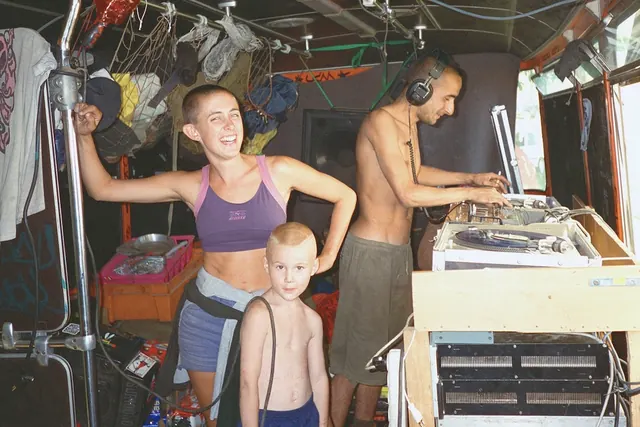
The heady rave scene of the 1990s is much-mythologised in our collective imagination, and Vinca Petersen’ s No System is an unvarnished, insider’s portrayal of this bygone time. The cult photo book, published in 1999, tells the story of the photographer’s ten years living nomadically, putting on free parties around Europe with various sound systems.
The free-wheeling spirit and democratic way of life she captured has captivated viewers ever since; Petersen has since published a second edition of the book, and is preparing to show a constellation of the work in Tate Britain’s upcoming exhibition The 90s: Art and Fashion , curated by Edward Enninful .
To coincide, Petersen decided to revisit the archive through a different lens. NO SYSTEM: UNSEEN VOL 1 is a zine made in collaboration with Gem Fletcher .
Rather than the DJs, the dancing, the style or the sound systems, it focuses on the in-between moments of community and care, which, for Petersen, defined the scene. “There’s always been so much behind the obvious side of the rave – the drugs, the music, all of that,” says Petersen.
“People often focus on the extremes of it, but I was always fascinated by the more nuanced things – the real life, the human stories.”
Her archive exists as thousands of 6x4 prints stored in boxes – “a continuous thread”, organised loosely by date. The selection of around 50 images was made with Fletcher, while Jamie Allen Shaw worked on the design. “The archive could be cut in so many different ways,” says Fletcher, “but we really wanted to find those intimate moments of chosen family, of care and being in community, of working together in small, yet meaningful ways.”
It was partly a recent life change that prompted Petersen to revisit the images through this lens. For the past four years, she has been living on the Isle of Skye, building a straw-bale house with the help of more than 50 people.
The body of work that emerged, HULALA , captures a way of life similar to that of the rave scene, built on reciprocal relationships. “On the surface these bodies of work obviously look very different,” she says.
“And yet there is a continuation of thought.” Petersen offers an analogy: “It’s like an onion. When you first look at the pictures from the raves, what you see is this fascinating first layer: the haircuts, the dancing, the crowds… But then you start to notice the next layer… an arm around a shoulder, a hand in a hand, a child laughing and playing in the background.”
These are basic acts and far from unattainable, but in our current world, where digital services are increasingly replacing human interaction, it feels like the notion of relying on our communities for resources has been lost. Cutting each other’s hair, cooking a meal together, giving your neighbours lifts to the airport.
At what point did these ideas become radical? And how do we look for freedom in a world that feels like it’s closing in?
“We all feel a bit overwhelmed right now,” says Petersen. “The world has gone from being something to rebel against, to something that’s just absurd in a lot of ways.” These images are a reminder that freedom can be found in everyday acts.
Whether you’re at the rave or building a straw house, it’s about being intentional and sharing what you can: food, music, cigarettes or just a conversation. “I guess all I feel I can offer, through something as simple as photos, is spreading those ideas that can encourage small changes – within people, within us and within society.”
Vinca Petersen’s NO SYSTEM: UNSEEN VOL 1 is available now.
Get must-see stories direct to your inbox every weekday.
While Madonna and Taylor Swift dominated the trophies, Charli, Troye, Tyla and PinkPantheress were the true winners in the style stakes