
‘Slow living’ has become an overused buzzword in travel, casually tagged to anything from linen-clad interiors to beige minimalism masquerading as an ‘off-grid’ experience, but at a hotel in Sartène, it’s the natural way of things.
Set within the wild and unspoiled Ortolo Valley in southern Corsica, A Mandria di Murtoli isn’t easy to find but drive down a sandy track and through an inconspicuous wrought-iron gate and you’ll discover something that seems less like a hotel than a restored pastoral hamlet. A scattering of former landlord’s mansions, shepherds’ cottages and stables – some dating back to the 17 th century – have been transformed into idyllic suites full of rustic charm.
The structures may be old, but the hotel itself is new – having opened in June last year – and still very much a hidden gem. It’s the latest addition to the celebrated Domaine de Murtoli , a sprawling private estate set across 2,500 hectares of wild valleys, mountains and pristine beaches.
Time appears to dissolve here; everything is unhurried and check in isn’t a fanfare event. Rather, you’re given a key that looks like something from a fairytale, led down a stone pathway and then left to enjoy your new home for the next few days. The rest of A Mandria’s winding pathways, meanwhile, connect to a large brick-lined pool, a bar and a restaurant, all cradled within stunning, sweeping views of the Orotlo Valley.
Accommodation is within weathered stone houses that are spread out and hidden amongst fragrant maquis, wild herbs and centuries-old olive and citrus trees. But don’t mistake old for shabby; whether you’re staying in a restored sheepfold, stable or converted barn, each home showcases the beauty of Corsican craftsmanship.
Original stone walls, vaulted ceilings and exposed wooden beams have been lovingly preserved and meticulously restored. Painted terracotta tiles and exposed brickwork provide pops of colour and add rustic charm, but luxury isn’t lacking either.
Suites come with a plunge pool and private gardens, but the biggest indulgence of all is the serenity that comes with a property with only ten rooms and suites.
There’s a deep connection to the land that’s reflected everywhere, but to understand A Mandria di Murtoli, you have to understand the Domaine de Murtoli actually is. The estate, which feels like its own little world, is owned by native Corsican Paul Canarelli. He inherited the land from his grandfather in 1993 and began restoring the traditional dwellings but also adding discreet comforts like pools, landscaped gardens, and even a golf course.
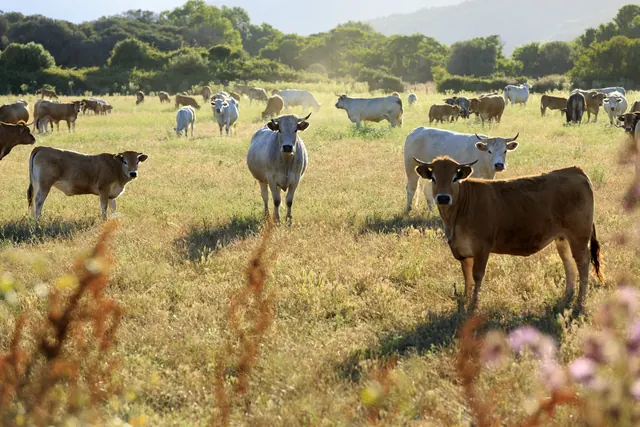
Alongside the restoration came the important work of reviving centuries-old agro-pastoral traditions. The estate is almost entirely self-sufficient, producing its own cheese, beef, lamb, eggs, honey, olive oil, vegetables, herbs and more.
The farm, located next to A Mandria, supplies much of what lands on the plate at the hotel’s restaurant L’Appuntamento, which marries traditional Italian cuisine with Corsican ingredients grown just a few steps away. Standout plates include literally any of the homemade pasta dishes, but also the roasted seasonal vegetables, eggplant parmigiana and, of course, a classic tiramisu.
At A Mandria, it’s all about enjoying the simple pleasures of life and relaxing by the pool is actively encouraged, but if you’re a little restless, guests have access to the entire Domaine de Murtoli estate, including all of its restaurants (if you pick just one, make it La Table de la Grotte, which is set inside a candlelit natural cave), a Kyle Phillips-designed golf course and a spa. The private sandy beach, Plage d’Erbaju, is lined with driftwood-constructed cabanas overlooking the Mediterranean Sea and has a fantastic restaurant (La Table de la Plage) serving some of the best and freshest seafood on the island.
In Corsica, nature is ever present. No matter which direction you go in, you’re surrounded by the sea, countryside and mountains. To make the most of it, the Domaine offers activities from hiking and horseback riding to stargazing or botanical walks guided by a local shepherd.
Travelling by foot will only take you so far though. A car with sturdy tyres is essential in this part of Corsica, where the roads are uneven and made of red sand, but we trust that every minute of the journey will be worth it for the magical idyll that is Domaine de Murtoli.
Find out more about A Mandria di Murtoli here .
words. J. Bibi Cooper edit. Huma Humayun photography. Camille Moirec
Through the tangle of Essaouira’s medina, the air is warm with leather and spice, and cats doze on faded, sun-bleached carpets. Down a narrow alleyway, the only clue is a great wooden door, worn smooth with age and painted a vivid Yves Klein blue.
Step through it and the clamour of the souk falls away. The light dims, the air turns cool, and past a small boutique glinting with Berber silver, a tray of fresh mint tea waits as if you were expected.
This is Villa Maroc , often called Morocco’s first riad hotel, and, three decades on, a family institution finding its way into a new generation’s hands.
In the late 1980s, British surfer James Waley fell for Essaouira and took on a single riad in the medina. Mounia Ezzaher ‘s parents came a few years later.
Her father had known the town since boyhood: the small blue fishing boats rowing in at dusk, light glowing gold over the water. It happened over a conversation in one of its salons: when Ezzaher’s parents asked whether the riad was for sale, the answer came back on a torn scrap of paper, a price pencilled across it.
A week later they had signed; two months after that, Villa Maroc was home.
Now encompassing four riads, the hotel has just 21 rooms and no two are alike. Each has the intimacy of a home long loved, furnished with antique pieces, worn textiles and original artwork collected over the years. The rooms feel gently out of step with the present: no television screens, only sweet pastries set out in embossed metalware, orange-blossom soap and the call of gulls over the harbour.
Beyond the rooms, the house unfolds slowly: a cool warren of staircases, courtyards and shady corners made for losing an afternoon in. The roof terrace climbs in levels over the ramparts towards the water and palm-fringed coast.
The whole riad seems to exhale and wants its guests to do the same. “I want them to feel very in Morocco – like they can take a break,” Ezzaher says.
The aim is to show the country in every detail, giving Villa Maroc a spirit entirely its own.
Much of that spirit can be attributed to a marriage of two temperaments. Ezzaher’s mother is Swiss, her father Moroccan. “It’s a running joke in the family: Moroccan hospitality and Swiss precision,” she says. Between the two sits a rare kind of ease.
That same duality carries through to the table. Dinner is served around an intimate, candle-lit courtyard, with seats low and drawn close.
Each evening brings a different set menu, with no choices to weigh, built on the conviction that Moroccan cooking runs far deeper than the tagine most travellers know. On the night Schön! alive dined, that meant spiced oranges with black olives and garlic, followed by slow-cooked goat, so tender it fell from the bone.
Removing the choice, as Ezzaher sees it, allows guests to surrender to the meal, and to meet dishes they would never think to order for themselves.
Much of what is on the table comes from the family’s own acreage. Drive inland, through open, sun-worn country, where wild horses roam free, and the olive groves appear.
This is the Domaine, the family’s other life’s work: an olive and argan farm with its own mill. Ezzaher’s mother, unconvinced by the local olive oil, took to travelling with her own bottle from Tuscany; her husband, an engineer with no background in farming, resolved to outdo it.
He learned the craft from producers in Spain and Italy. What began as a private project is now a working estate, producing more than 20 tonnes of oil last year, pressed from trees harvested between October and December.
Over time, that pride settled into something quietly principled. Nearly everyone who works the land comes from the surrounding villages. Even the waste closes a loop: the crushed olive stones are dried and burned to heat the pool at Les Jardins , the family’s contemporary sister property nearby. It was never badged as a sustainability drive; it simply made sense.
Left: a wild horse and Right: Mounia Ezzaher and her father, both at Domaine Villa Maroc
Now the story passes onto the next generation. Ezzaher is now General Manager, after her parents stepped back this year with an unhurried handover no manual could capture.
She had, she says, “dreamed about taking over since I was a little girl”: not to remake Villa Maroc, but to build gently on what was already here. If anything, she wanted to give the place’s long history its due: there was, she felt, “such a big story to tell”.
In the end, it is the slowness that stays with you. Mint tea that arrives unprompted; the afternoon light pooling in the worn reds of a Berber rug; the call to prayer rising over the medina as evening settles. Villa Maroc has never chased the times, only grown more surely into itself. That, long after the blue door has closed behind you, is what you carry home.
Find out more about Villa Maroc here and Domaine Villa Maroc here .
edit. Huma Humayun images. Courtesy of Villa Maroc
Serenissima. Away from the crowds, Hotel Cipriani offers the luxury of privacy. belmond.com
What do a bartender, the entrepreneur behind Sea Containers, a famous architect and George Clooney have in common? The answer is Hotel Cipriani in Venice, the star-studded venue that has been synonymous with la dolce vita for almost 70 years. To understand its story, however, we must travel further back than that…
Back in 1927, a Bostonian by the name of Harry Pickering walked into the bar of the Hotel Europa-Britannia in Venice, which he often frequented. Unfortunately, he had run out of funds, but a young – and rather generous – bartender lent him 1,000 lire to purchase a ticket home.
It was not until 1931 that Pickering returned, but when he did, he paid back his debt fourfold. The bartender, born in 1900 in Verona, was called Giuseppe Cipriani.
He used the cash to open his own bar, which he named after his American benefactor.
See the full feature now only in Schön! alive .
The place to be. The hotel’s pool – the largest in Venice – is the symbol of the city’s dolce vita
A legacy project. Peter Marino in the newly designed reception area
Room with a view. Hotel Cipriani’s site boasts 270-degree vistas of the water. The Dogaressa Signature Suite, for example, affords a beautiful view of St Mark’s bay.
Get your print copy of Schön! alive at our Schön! store and at Amazon . Download your eBook .
words. Huma Humayun images. Courtesy of Belmond
Dana Lixenberg, Daniel Arnold and Feng Li for Rimowa.
Our daily commute probably doesn’t feel worthy of an entry in a travel diary, but Rimowa believes the journey from A to B doesn’t always have to be dull. For its latest campaign, the German Maison expands its ‘ Never Still’ leather collection with a series of compact silhouettes built for routine travel, following people through Amsterdam, Los Angeles and Shanghai.
Photographers Dana Lixenberg , Daniel Arnold and Feng Li track and frame the shortest daily journeys as stories worth documenting, finding beauty in the most ordinary moments.
The update introduces two rich colour choices: a deep, smoky Anthracite grey and a muted Mocha brown, both engineered from full-grain leather that naturally patinates over time. The signature Never Still Flap Backpack debuts in a smaller size in the new Mocha hue, featuring the house’s iconic embossed luggage grooves alongside a padded back panel and a suitcase attachment sleeve.
This joins a permanent large option in Anthracite, running parallel to the new Never Still Leather Duffle systems which land in large and medium configurations. For lighter transit, the collection introduces a compact, zipped Cross-Body Bag and the sleek Leather Zipped Tote, an entirely black, pebble-grained companion proportioned to hold a 13-inch laptop in place of a traditional briefcase.
The new Anthracite colour also makes its way into Rimowa’s Distinct collection, giving the leather suitcase a darker, smoky character. Made at the Maison’s historic Cologne factory, the Cabin combines its signature grooves with lightly pebbled leather, colour-matched aluminium corners, palladium hardware and a robust leather-wrapped construction designed to develop a unique patina through long-term wear.
Travel does not always mean boarding a plane or disappearing for a month; sometimes it means a train, a taxi, a walk across town or simply carrying everything you need through another very busy Tuesday. ‘Never Still’ is designed for all of it.
The expanded Rimowa leather collections are available now across global flagship boutiques and online. Find out more here .
photography. courtesy of Dana Lixenberg , Daniel Arnold and Feng Li for Rimowa words. Gennaro Costanzo