
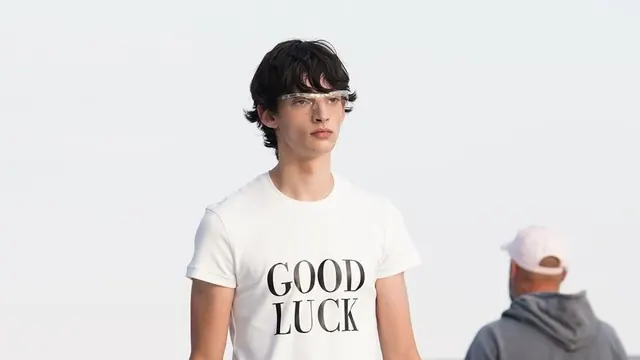
When Simone Rizzo and Loris Messina were announced as creative directors of Moschino in June, after stepping back from their brand Sunnei the September before, we all expected they would fuse Moschino’s satirical history with their own clever show concepts.
Sure enough, as the show started on the roof of the Unipol Dome, scores of people, all with individual styles, began to walk the runway en masse. It felt like people watching on a busy city street: some talked on the phone, some walked their dog, some looked like they’d just left work or school, others looked like they’d just left the club.
And then suddenly, Moschino models walked in the opposite direction down the middle of them, in vibrant looks that completely stood out against the backdrop of real life.
“I think it was wonderful and very refreshing,” said Marco Gobbetti, former CEO of Moschino, who joined the board of parent company Aeffe last year. “Everything was perfect: the occasion, the beauty, the idea.
Franco Moschino was a thinker. He was a philosopher.
He was a painter. So I think the potential of Moschino is to be more than just a brand that makes garments.
It should be a cultural platform for ideas. Simone and Loris are the people that can really create a new Moschino.”
Moschino, launched in 1983 by Franco Moschino, is a house built on wink-wink satire, trompe l’oeil and visual trickery. And as Rizzo and Messina told Vogue Runway’s Tiziana Cardini pre-show, they’ve been “meticulously studying why Moschino made sense”, but they don’t want to replicate the founding designer’s work.
They are moving away from the very loud references to the Moschino archive, and — rather than riffing off their predecessors Rossella Jardini, Jeremy Scott and Adrian Appiolaza — the plan, they said, is to “create a Moschino of the future”.
At Sunnei, Rizzo and Messina were known for clever show concepts that satirized or questioned the strict rules of the fashion industry. From the audience judging looks in real time (SS24) to a live auction with fake money (SS26) and models walking to their inner thoughts as the soundtrack (FW24), the show concept was never short of paradoxical, but the gimmicks typically didn’t extend to Sunnei’s clothes, which were always rooted in real life.
Today’s show featured bold elements, with a vibrant palette of primary colors, panniers and padding that created the illusion of an enormous bottom, or exaggerated green fringing on Bermuda shorts that gave an audible swish as the models walked by. The show was produced without a stylist, a rare occurrence among today’s luxury houses.
And it’s just the first step in what Gobbetti expects will be a long and fruitful journey for the duo at Moschino.
“Of course, this is the first collection. It was done in two months,” he said. “There will be lots more. And there’s already lots of ideas. We want to take the brand where Franco Moschino positioned it. And so we’ll try.”
The duo will need to translate this positioning into commercial success. In May, Aeffe, which also owns Alberta Ferretti and Pollini, told its shareholders that it was insolvent, following over 200 layoffs at the end of 2025.
The group named Riccardo Bagolin as general manager in June, to help steer a turnaround of the business, which reported net debt of approximately €112.6 million in July. The Ferretti family pledged €115 million to save the company.
Executives are now riding on creativity to propel the Aeffe labels, with Moschino being by far the biggest brand on its roster.
Here’s what industry insiders had to say about the debut.
Francesca Ragazzi, head of editorial content, Vogue Italia
The show was phenomenal. I loved the inspiration of real life in the streets.
Then all of a sudden you see the models arriving, and it feels so real. I loved the skirts and the pants with the fringes, the colors.
I loved the bags. I loved the toe sandals.
I love the boys. I wish them the ‘good luck’ that was on a T-shirt in the collection.
There were so many people from our community in the show. I think this show was a good sign of a new generation in fashion that wants to be very authentic.
Miyako Bellizzi, costume designer and stylist
I was very surprised, in a good way. I had an idea what the collection would be like because of my dress, so I was curious of what it was going to be about.
It was the first show this week that I felt emotional. I don’t know why, but maybe it was because of the influx of people, it felt very real.
I loved the colors and the textures and how everything moved. And I loved the play on human body and form, and so my favorite thing was the big skirts and how when you see them walk away, like their butt is kind of bouncing.
It was incredible.
Manuel Marelli, head of buying, 10 Corso Como
Moschino felt fresh. Their show concept was, as always, cool, unexpected and very original. I actually quite liked the collection, it feels like they’ve taken a step forward. Still playful and ironic, but more complete and cohesive this time. Definitely a good start.
José Criales-Unzueta, style correspondent, Vanity Fair
This was a very fun and clever show that helped the designers establish the tone of their Moschino. But it was also very bold to show their new collection amongst a sea of very cool people with their own style identities. Does the new Moschino hold up against some cool Milanese folks? For the most part! Either way, I love and respect that kind of confidence, and can’t wait for the next one.
Carlo Capasa, chair, Camera Nazionale della Moda Italiana
We are very happy that one of the highlights of this Milano Fashion Week is the debut of two talented designers at the creative helm of Moschino, an important name in Italian fashion. Creativity is at the heart of our fashion system, and seeing a new generation of designers bring their talent, energy and creative vision to our week is a strong expression of its vitality.